
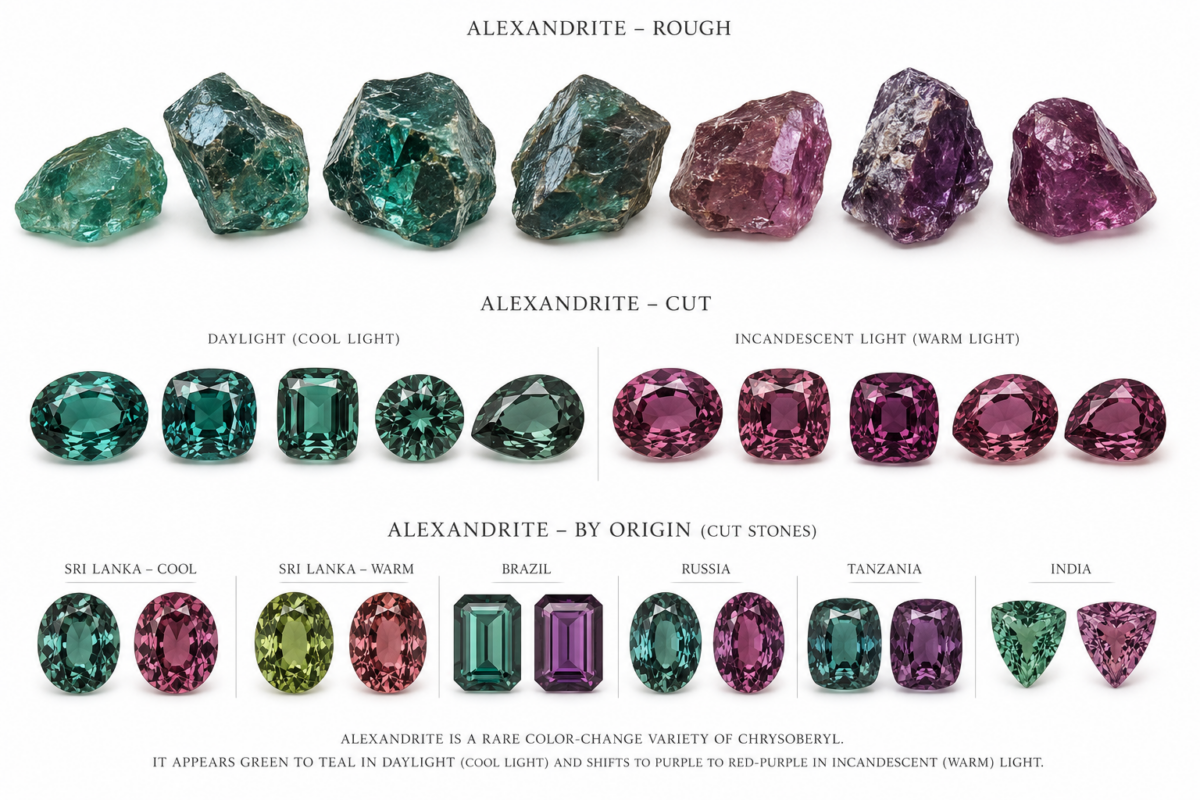
Some gemstones sparkle. Some gemstones glow. And then there is alexandrite. It is a gemstone so fascinating that it appears to change its personality depending on the light, much like the Zodiac sign Gemini. No wonder that they belong with each other with Alexandrite being a birthstone of June along with pearl and moonstone. As a pleochroic gem, looks green in daylight and looks reddish-purple under artificial light, representing the dichotomous nature of true Geminis.
Alexandrite belongs to the mineral family known as chrysoberyl. Chemically, it is composed of beryllium aluminium oxide (BeAl₂O₄), and traces of chromium within its crystal structure are responsible for its famous colour-changing effect. This optical phenomenon occurs because alexandrite absorbs and reflects different wavelengths of light depending on the light source. Further, it can show chatoyancy or Cat’s eye effect as well apart from the colour-change.

Origins of Alexandrite
The story of alexandrite begins in the 1830s in Russia’s Ural Mountains, a region renowned for producing exceptional gemstones. According to the Gemological Institute of America (GIA), the gem was named after the future Tsar Alexander II of Russia. Due to its red and green colour corresponding with the military colours of Imperial Russia, the gemstone came to be associated with Russian aristocracy.
Although the original Russian deposits are largely exhausted today, alexandrite is also found in countries such as Brazil, Sri Lanka, Tanzania, Madagascar, Zimbabwe, and India. Each locality produces stones with slightly different colour characteristics, making origin an interesting aspect for collectors.
Some stones lack brightness and appear dark and others look brown rather than purple. These stones are typically treated to get better colouring.

Alexandrite in Jewellery
Alexandrite’s hardness of 8.5 on the Mohs scale makes it an excellent choice for jewellery. It is durable enough for rings, earrings, pendants, and bracelets. This could be a perfect stone for an engagement or a wedding ring for those born in June. The gemstone would also be the best gift for your partner on your 55th wedding anniversary.
One of the joys of wearing alexandrite jewellery is witnessing its transformation throughout the day. A pendant that appears green during a morning outing may reveal rich reddish tones at dinner. Few gemstones offer such an interactive experience.

Caring for Alexandrite Jewellery
Due to its hardness the stone is relatively easy to maintain. Clean it using warm water, mild soap, and a soft brush. But do avoid harsh chemicals and abrasive cleaning products.
Alexandrite – June Birthstone
As a June born, I looked high and low for a coloured gemstone that could be my birthstone. While moonstones do appear ethereal and pearls are elegant, nothing comes close to the magic of alexandrite. This gemstone is associated with balance, intuition, creativity, and good fortune. Some traditions suggest that the gem brings harmony between the physical and spiritual worlds, perhaps inspired by its dual colours. It serves as a reminder that in life one must be adaptable and change with changing times and lights.
I hope you find it interesting
Cheers


What do you think?