
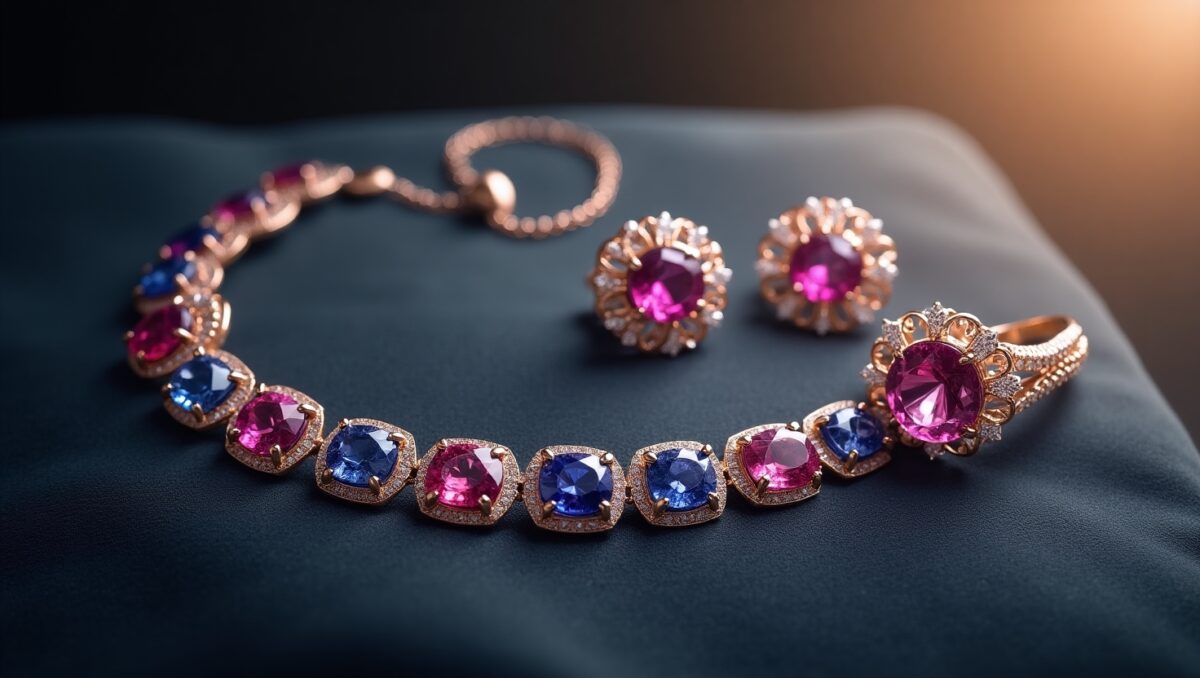
Sapphire, the birthstone of September, is one of the “big four” gemstones, the other three being ruby, emerald and diamond. Though the term Sapphire originating from “Sappheiros,” meaning blue stone, sapphires are available in a range of colours including colourless or white.
Origins and Ore
Much like a ruby – the birthstone of July, a sapphire also belongs to the corundum family. It is a crystalline form of aluminum oxide (Al₂O₃). Trace elements present during their formation give sapphires their vibrant colours. Typically, sapphires are mined from alluvial deposits and metamorphic rock formations. Major sources include Sri Lanka, Myanmar, Thailand, India, Madagascar, and Australia. Each produces stones with distinctive hues and qualities.

Chemical and Physical Properties
A sapphire measures 9 on the Mohs scale, making it hard and durable next only to diamonds. Hence it is suitable for engagement rings. Infact, designs such as the 12 carat sapphire engagement ring, as worn by Princess Diana, has been trending in 2025. The gemstone has a refractive Index of 1.76–1.77 and a trigonal/hexagonal crystal structure.

Lore and Symbolism
According to GIA, blue sapphire was believed to be an antidote to poison and cure for diseases of the eye and plague boils. Ancient Persians thought the earth rested on a giant sapphire whose reflection made the sky blue. Blue Sapphires are believed to symbolise heaven, and offer protection from treachery.
In the Shaivite origin story of navaratnas, blue sapphires originated from the piercing blue eyes of Valasura and yellow from his phlegm. As a Navaratna the dark blue sapphire (Neelam) is associated with the planet Saturn – Shani and yellow sapphire (Kanaka Pushparagam) with Jupiter or Guru. Both are believed to bring wealth, discipline, and spiritual insight. While a yellow sapphire can be worn by anyone but dark blue requires caution. If you want to please both planets then you can wear Pithambari – a bi-colored (yellow and blue) sapphire.
I was once told that a dark blue sapphire is an unfavourable stone for me. But because I loved it, I found myself a lab grown sapphire ring and earring set thinking that lab grown gemstones might not vibrate in the same frequency as natural stones. I even told myself that as I was going through the 7.5 phase on Saturn in my sign, it will not bring any harm. However, to my regret, I found the set unlucky and was fortunate enough to exchange it before it caused too many issues.

September birthstone and wedding anniversary gift
Regardless of the colour, sapphire is the birthstone of September. Due to its brilliance and transparent nature it is the gift for 5th wedding anniversary. Its strength and durability make it as gift for the 45th wedding anniversary. If you are worried about the maleficent effects of dark blue sapphire, I suggest that you pick another colour, such as blue-green as a birthday or wedding gift.
Colours of Sapphire
When you think of sapphire the first colour that comes to mind is the cornflower blue of Kashmir sapphires. Dwindling supplies made man look at intense Myanmar blues and those from Sri Lanka. While blue is the most iconic, sapphires occur in nearly every shade. Padparadscha meaning “lotus blossom” in Sinhalese is one of the most expensive varieties of sapphires. Its pink-orange colour acts a reminder of exotic sunsets. Yellows are created by the presence of iron impurities and linked with knowledge and guidance.

If you love green or teal colour, then Australian sapphires sometimes referred to as “mermaid sapphires” may interest you. Most brilliant with clear hues are Montana sapphires from Rock Creek, USA and they come in a variety of colours including light sea greens, yellow greens and dark blue-greens. Pink corundums are sapphires with traces of chromium and not rubies and can range from a light pink to magenta. White sapphires are commonly used in Kemp jewellery from Vadassery and sometimes even in Kundan jewellery. They can be matte or brilliant depending on the quality of the stone and the cut.
A Star Sapphire is a pink or dark blue stone that exhibits an optical effect called asterism, where a six- or twelve-rayed star appears under direct light. This happens only wit ha cabochon and not a faceted stone. A famous star sapphire, called the Star of India is a 563.35 blue star sapphire. Interestingly, it was mined in Sri Lanka and not India.

Treatments and care
Sapphires, like rubies are routinely heat treated to improve colour. Dyeing, fracture filling and lattice diffusion are other treatments used. A treated stone might be 30-50% cheaper than an untreated stone, depending on the treatment. However, a treated stone requires more care and cannot be used as everyday wear. Alternatively, if cost is the issue, you can go in for lab grown stones with excellent colour and clarity at a fraction of the price of the natural stone.
Sapphires can be cut in many shapes including round, oval, emerald, pear, marquise and even hexagon. It can be used in various settings such as prong, bezel, tension and invisible setting. However, it is a gemstone that looks best in simple settings that keeps the focus on the stone.
I hope that this post will help you shop smarter for the September birthstone sapphire. Do read other posts in the birthstone series here.
Until then, I hope you find this interesting
Cheers


What do you think?