
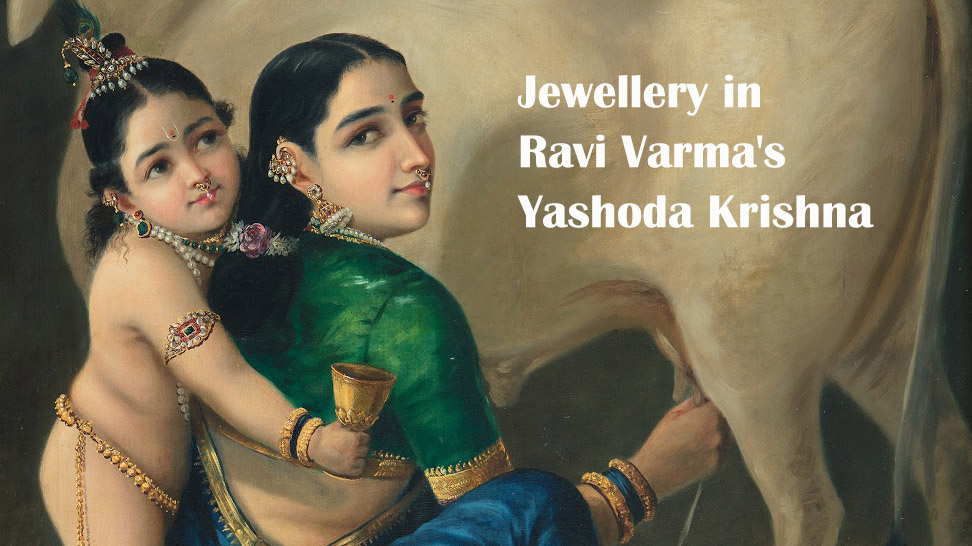
Raja Ravi Varma’s “Yashoda and Krishna,” painted in 1895 became sensational recently as Mr. Cyrus Poonawala purchased it for Rs.167 crores from Saffronart Gallery. But that is not why I am discussing it. The painting is great example to understand how the artist Ravi Varma adorned divinity creating a pan-Indian adornment aesthetic.
Ravi Varma’s vision and his works are a perennial influence for me. I revisited his works in late 2025 for my research after making my first collection of picture jewellery – Chithiram based on his paintings in 2012.

Painting Textiles and jewellery
Ravi Varma’s paintings of Royals and Nobles from particular regions are almost like ethnographical portraits. They wear the actual clothing and jewellery worn by people from that region. In his paintings he adorned women with traditional textiles like as Maheshwari and Chanderi (from Madhya Pradesh but worn but royals of several states), Paithani (Maharashtra) and Kasavu (Keralam). See some of his paintings virtually on the Ravi Varma Foundation website.
According to Historian Dr. Usha Balakrishnan, Ravi Varma was highly influenced by Tanjore painting and brought in the visuality of glittering gemstones set in gold as specific ornaments. He also took inspiration from actual pieces of jewellery that he saw. There are stories of how he mapped actual sizes of stone so that they look like the real ornament when he painted them. The jewels were represented on canvas through the Impasto technique of applying thick layers of paints. This technique gave both the textiles and the jewels a tactile quality. His pearls look 3D, perfectly spherical with a warm lustre and a glistening nacre.


Adorning the divine
But his divine images are different. Drawing from his experience of living and working in the royal households of Travancore, Hyderabad, Baroda and Mysore, he created a composite style of adorning the divine. It is almost as if he wants to say that the Gods belong to all.
In his paintings of the divine, the Chanderis of Madhya Pradesh and Paithani of Maharashtra can be seen along with the kaasumala and addigai from Tamil Nadu. However, there is a strong Travancore influence. In the painting in the centre, (of Krishna being dressed), he is wearing a mini Veera Srunkhala which is an actual bangle-bracelet commissioned and gifted by Maharajas of Travancore to their loyalists. Different types of traditional Indian jewellery from across the country can be seen in a single image. You can see him reusing jewels from one painting to another, just as a stylist would create several looks with items from their own wardrobe. Compare the paintings in this post and you will see similar jewels being used in different paintings.

Jewellery in Ravi Varma’s Yashoda Krishna
Based on a purely visual analysis, here is the list of the jewellery in Ravi Varma’s Yashoda Krishna painting that I can identify. Since I am using terms from different languages, I am using the following legend to identify the language. T – Tamil, Te – Telugu, H – Hindi, S – Sanskrit and E – English.
Yashoda
- Bullaku (T) – Septum ring
- Katherabaneelu + Bugadi/koppu (Te) – earrings on the earlobe
- Thodu + Jimikki (T)- stud and drop earrings.
- Muthu maalai (T) – the layered pearl necklace.
- Gold chain (E)
- Valaiyal (T) – gold bangles and glass bangles
- Metti (T), Bichiya (H) – Toe rings
Krishna
- Sarpech (H)/Aigrette (French) – the jewelled plume foregrounding the peacock-feather
- Earrings on the ear lobe (looks very similar to the septum ring). Used to be worn in Tamil Nadu along with Bugadi, Thandatti and Pambadam
- Ruby and emerald mango earrings
- Bullaku (T) – Septum ring
- Gold addigai/short necklace
- Emerald bead necklace
- Muthu maalai (T)/ Muktavali (S) – the pearl strands around the neck.
- Bajuband (H) or Keyura (S) – Armlet (Kundan technique with polki stones)
- Valaiyal: Once again a combination of gold and glass bangles.
- Vadanam/ oddiyanam (T): Gold Hip Chain with a lagniappe
- Nupuram (S) (T) – Anklets with gold droplets, the first could be Kaal kaapu (T) (stiff anklets for babies) or Paadagam (T)
The Pan-Indian Aesthetic
While many critics of Ravi Varma say that he pushed a pan-Indian-elite visual language inspired by European oil paintings, I say that it has led to something for the lack of a better word, the “Indian Aesthetic.” As a heterogeneous country with complex regional flavours, styles and local traditions this is problematic from a culture studies point of view. However, we cannot deny Ravi Varma’s role as a 19th century Indian fashion director, a trend setter. Especially as many film and fashion directors have tried to do it in the past decade and have failed.
His composite aesthetic is what has become the master template for Indian fashion today. Wearing a Kancheevaram saree with a Jadau-kundan necklace has become the norm. But this phenomenon is not entirely new. The aigrette with a plume or sarpech had reached the courts of Maharaja Karthigai Thirunal Rama Varma of Travancore in the 18th century and was no longer an ornament specific to North Western India. It captured the fascination of American and European fashionistas in the early 20th century that many associate it with Jazz performers and Flappers.
As a trend spotter and a fashion educator, I find it crucial to study history to see how jewellery styles have both evolved and sustained over time. It allows me to have a greater appreciation for items such as bugadi and koppu when they come back in trend. These items which were almost extinct, are now available in plenty and not only women but men are also wearing them.
Previous posts on Indian Jewellery history
- Ancient Indian Jewellery – Head to toe
- Jewellery as described in Natya Shastra
- Jewellery as described in Silapathikaram
I hope you find it interesting
Cheers


What do you think?