
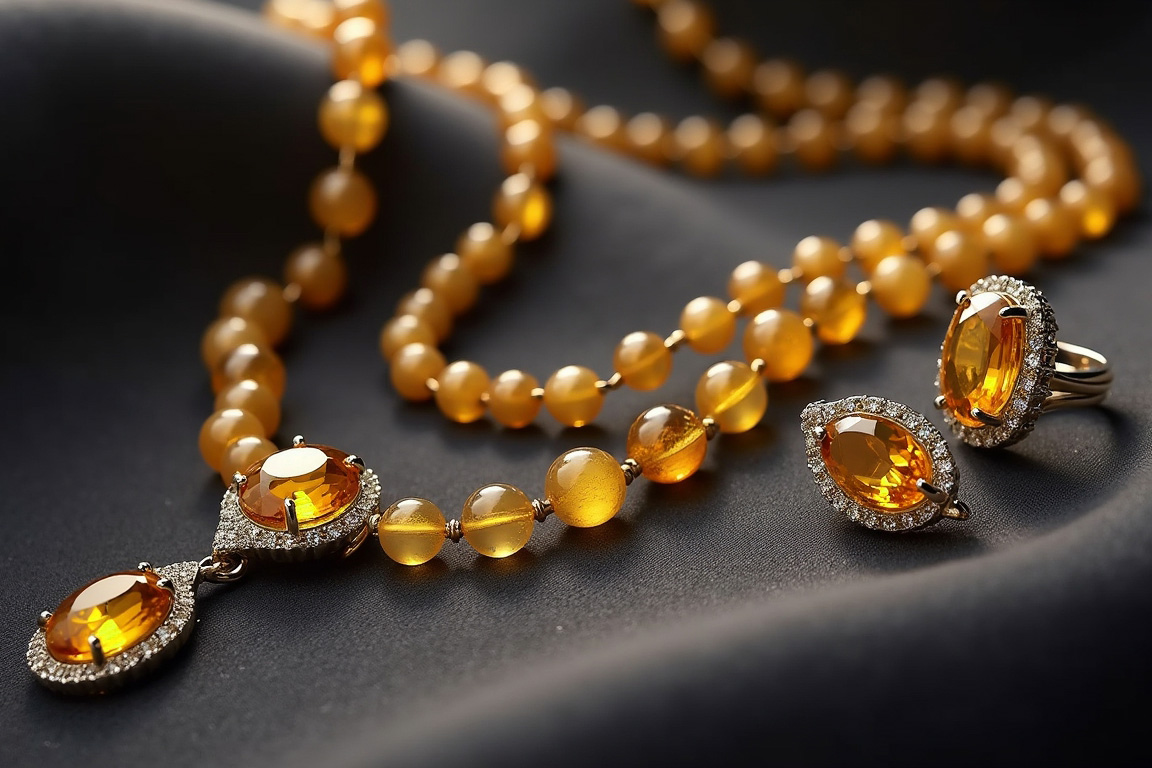
Named by theGerman mineralogist Georg Bauer, Citrine is the birthstone of November. The word citrine, derived from the French Citron indicates the lemon yellow colour. However, as you can see in the image below, the yellow gemstone is available in colours from light yellow to a reddish brown.

Source and Composition
Referred to as Sunela in India, citrine is a crystal quartz or a Silicon dioxide (SiO₂) compound with a trigonal crystal structure. It has the refractive index of 1.544 to 1.553. Citrine is often confused with yellow topaz, which is an Aluminium Silicate with fluorine and hydroxyl atoms (Al2SiO4(F, OH)2). The yellow colour in citrine comes from the trace amounts of iron in the chemical structure. Naturally occurring translucent citrine is relatively rare. Most of the citrine seen in the market today is either amethyst or smoky quartz that is heat treated.
Apart from Bolivia, citrine can also be found in Mexico, Madagascar, Russia, Zambia, and Uruguay. Stones without inclusions are prized.

Symbolism and associated meanings
Due to its colour, citrine is considered to be a symbol of sunlight, warmth, and rejuvenation. Furthermore, it represents joy, optimism, positivity, and creativity. Citrine is known as Merchant’s Stone. Feng Shui experts recommend that it be placed in cash boxes to attract wealth. It is associated with both financial and intellectual wealth in India.
Legend has it that, Anahí (a-na-e) mine which is one of the most bountiful Bolivianite or Ametrine (yellow citrine + purple amethyst) mines in the world was given to as dowry to Don Phillipe when he married Princess Anahí. She was torn between her love for her country and her husband and ended up dying in her husband’s arms. The double coloured gemstone is considered to be a reflection of her being. Apart from producing the finest amertrines, the mine also produces beautiful natural citrines.

The birthstone of November as jewellery
With its warm, sunny and radiant glow, citrine is a prized autumnal gemstone and the birthstone of November along with topaz. It is both the colour and gift for the 13th (wedding) anniversary.
Citrine works well with both warm and cold tone metals. If you want a dense or heavy look use yellow gold and silver or white gold if you want a softer, elegant look. The gemstone is versatile and can be cut in different ways including cushion, emerald, marquise, etc,. Since it is a relatively soft stone with only a 7 rating on the Mohs scale, it was used to make intaglios and carved gemstone cabochons by Hellenistic Greeks and Romans.
If you are a November baby or simply someone who loves glowing gems, citrine brings brilliance and warmth that you can wear every day.
I hope you find it interesting
Cheers


What do you think?