
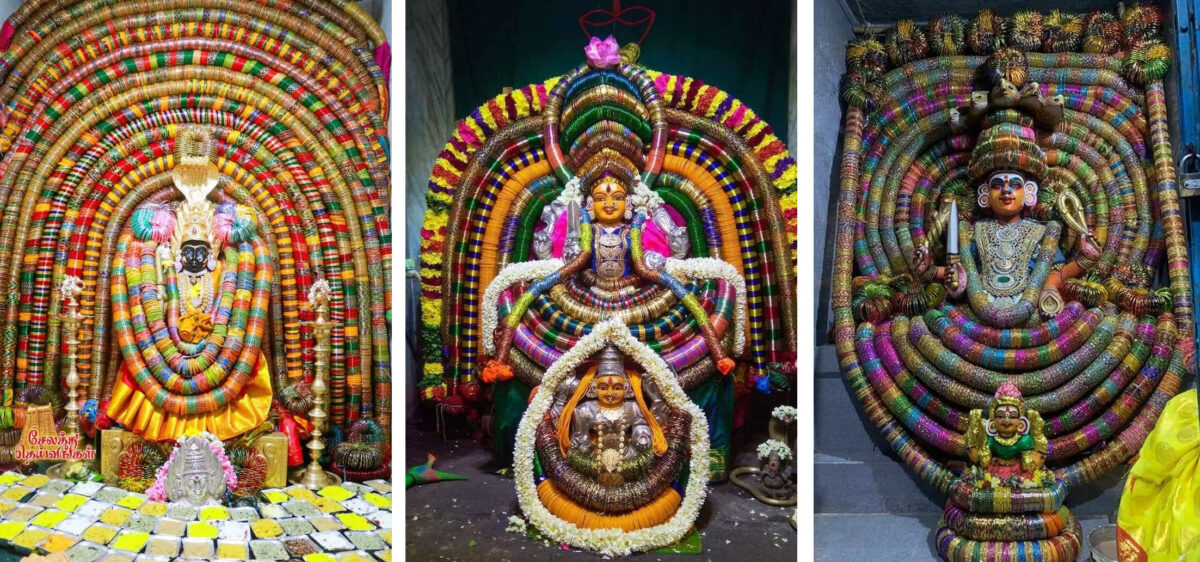
Imagine a festival that celebrates sisterhood, womanhood and fertility with jewellery. Now imagine it as a month long festival where anything other than this celebration of the sacred female is considered unholy. That is the Tamil month of Aadi, the period of 30 days in July- August and when the Mother Goddess is worshiped with bangles, flowers and offerings of koozh.
The Tamil Month of Aadi
The ancient Tamil people knew the importance of caring for feminine energy, for it makes the world function. Millenniums before the western world studied menopause and determined a woman’s need to appreciate herself and rest, Tamilians designated an entire month to pause, reflect, and reset with the divine feminine as our guide. They picked a time of transition between the summer and rainy season, as the time for thinking about ourselves and others.

Celebrations in Aadi
There are multiple important celebrations during Aadi – Aadi Pooram, Aadi perukku, Aadi Ammavasya and Aadi Velli (Fridays in the month of Aadi) and Aadi Nyayiru (Sundays in the month of Aadi). Newly weds are showered with gifts and then separated for a month to protect mothers delivering babies in the hottest months of the next year.
Rivers, particularly river Kaveri is celebrated on Aadi perukku. Families throng the river banks and have picnics. The role of rivers as a life giving and life saving force is contemplated upon. Aadi Amavasai is the New Moon day dedicated to honoring departed souls through special prayers and rituals, seeking their blessings. Varlakshmi Vratam or Var Mahalakshmi is to welcome home Goddess Lakshmi as the daughter who is the giver of different types of wealth.
Aadi Pooram is the birth star of Andal of Srivilliputhur and is celebrated as a Temple car (Ther) festival. Bangles are bought for daughters and grand daughters who come home to celebrate the festival each year. While the Goddesses and their temples are decorated with glass bangles throughout the month, it is on Aadi Pooram you will see the most ornate decoration.

Rituals of Worship
On Friday and Sundays evenings, temple icons of various Hindu Goddesses are decorated with fabrics of bright colours, glass bangles, flowers and turmeric. Vermilion or Kumkum is offered by women with period or reproductive issues. Sometimes, the offerings are also done on behalf of someone. Some temples organise temple cars or swing festivals. Colourful luminaries light up the streets. Colours such as yellow and red are worn for they represent prosperity, ritual purity and feminine energy. There might also be music and dance performances – both folk and classical as a part of the festivities.

Women gather in the temple courtyards or even on the streets to make pongal (rice and lentils cooked in milk) or koozh (porridge). They offer it to the Goddess with a prayer to protect their families and offer it to the poor and needy. While the month has only four weekends like every other month, in Chennai unlike other cities in Tamil Nadu, I have seen people make koozh for eight or ten weekends. It may be the mother’s way of making sure that her most vulnerable children never go hungry.

Why we Celebrate Aadi with Bangles
In an old post on “everything about bangles,” I had stressed upon how bangles, as a unbroken circular ornament symbolise life and fertility. Therefore, a pregnant woman is adorned with glass bangles to celebrate her fertility. This ceremony is known as Valaikappu – Valai meaning bangle and kappu meaning amulet signifying theprotective nature of the ornament. The circular nature of the glass bangles are believed to protect her from evil eye and any other negative energy that she encounters. The jingling bangles can be used by the mother to signal for help if she cannot speak and also aids in the sensory development of the growing fetus.
The sanctum in a Hindu temple is referred to as the Garba Griha or the womb. The divine mother or Amman is believed to care for the whole world as though she is pregnant with it. Therefore, her valaikappu is performed every Aadi to revitalise her and protect her and consequently us – her children, from evil. Bangles strengthen the hands that carry us and care for us. The circles also balance the energies and keeps her anger in check. It is for all these reasons, that human mothers too are gifted with bangles.
Another reason to celebrate Aadi with bangles is linked to oral traditions of various Goddess appearing in dreams of a bangle merchant or a business man and asking for beautiful bangles to wear. Therefore, people offer new bangles whilst praying for health, wealth, and prosperity.

As thousands of glass bangles are offered to the Goddess during the month, her form cannot wear them all. Therefore, they are used to decorate her shrine or sanctum. These are later redistributed to women who visit the temple. The act of wearing bangles blessed by Amman is believed to bring protection from evil, harmony in marriage, and destruction of past afflictions, obstacles, or karmic cycles.
Check out the various bangle mala making videos on Youtube. Most of them are not in English but fairly self explanatory.

Why glass bangles?
Both glass and precious metal are off the earth and are melted before they can take shape as jewellery. They undergo either blowing or casting to get their form, their design. As pregnancy is a labourious process that transforms a woman, both glass and metal bangles become appropriate signifiers. They both shine, reflecting the evil-eye and its negative effects away from the wearer. However, glass is more delicate, and yet sharp when broken, which once again reflects the qualities of a woman. Sri Easwaran extols the properties of glass bangles in this post.
While both precious metal and glass bangles can be gifted, glass bangles are chosen for their cost. There are devotees who will donate metal or stone studded bangles, but this typically be a once in a lifetime occurrence. Interestingly, due to all the end-of-season sales and discounts during Aadi, people end up buying gold bangles.

While every celebration in Aadi has its own set of rituals, they are all about pausing and prioritising the feminine energy and the nurturer in ourselves, those around us and in nature. This is much needed in this fast paced world where we are constantly battling for the next adventure, next milestone and next win without looking inwards. What do you think? Tell me in the comments.
PS: Defining a bangle
It is tempting to call cuffs, hinged bracelets and open bracelets or cuffs as bangles for they belong to the same family. However, a bangle is an unbroken, uncut, fully circular piece of jewellery. A broken or cut bangle is believed to invite negative energy or hold on to it. Often, open kadas are worn for this reason – they invite and trap energy in them and stop it from entering the wearer’s body. However, they need to be cleansed regularly to get rid of the built up energy. If you ever use the term bangle with respect to traditional practices of India, including the presently popular DesiCore trend, please refer only to bangles.
I hope you find it interesting.
Keep celebrating the sacred female!
Cheers


What do you think?