
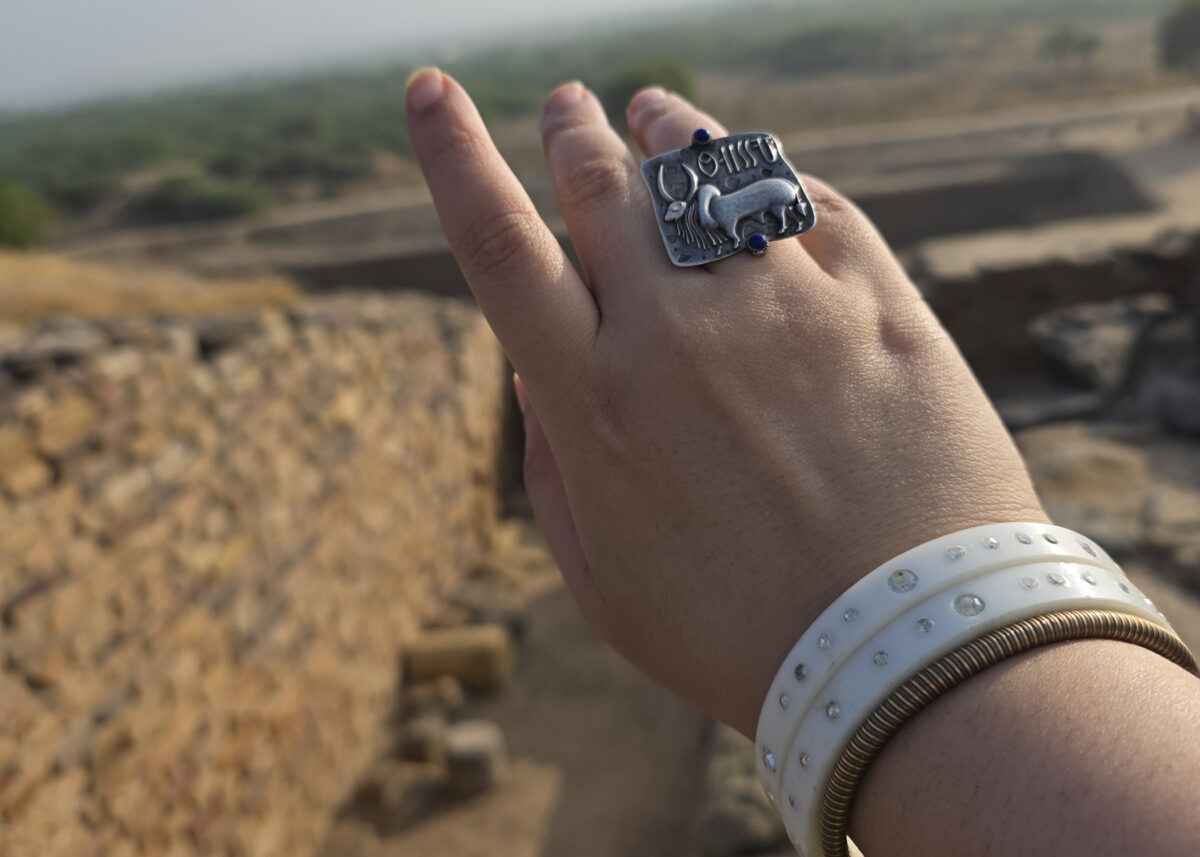
Beads play a significant role in recording the cultures of the past. They help us understand materials and material culture, belief systems, trade, evolution of technology and artistic expression. Beads have been continuously made, worn and traded in India since the Harappan times. During my trip to Kutch, in December 2025, I had the opportunity to visit see the remnants of the ancient Bead factories at Dholavira .

Dholavira
Situated in Kadhirbet island of Kutch, Gujarat, Dholavira is a Harappan site belonging to the Indus Saraswati Civilisation. It is a megalithic site protected by UNESCO as a World heritage site. It consists of the citadel, the castle, the Bailey, the midtown, and the lower town (European terms, I suspect). The citadel is a high rise mound. The castle is surrounded by ramparts and bailey is where officers are said to have resided. The castle is said to have been inhabited from 3500 BCE till 1450 BCE. But we do not know names of any specific royals who lived here. The circular houses or bungas which can be seen could have been the last stage additions to the site.

The Dholavirans were obsessed about water. They built their city at a site flanked by two river streams – Mansar and Manhar. They built several check dams and reservoirs to harvest and store water. There were several wells for rainwater harvesting, channels to distribute them to every house, plus public and private baths. See above one royal bath that is sort-of a spa for one. There were separate drains for freshwater and for sewage.
I also saw huge stadiums with tiered seating and a couple of phallus-like pillars. There was a signboard of characters that hasn’t been deciphered till date. Why did they choose to build a city in a desert surrounded by the sea, I wonder? Or was the geography drastically different in 3500 BCE?

Bead factories of Dholavira
According to our guide, several bead making factories functioned within the Citadel and in the Middletown. Making and selling beads for both local use as well as for foreign trade was an important activity.
In Fig 4, you can see a bead factory belonging to Stage VI (late Harappans 1850-1750 BCE) at Dholavira. Situated on the northern side of Bailey this bead workshop specialised in bead polishing. Only the remnants of two rooms remain and they have bead polishers. According to the information plaque at the site, the central depression could have been used for water to cool the beads while polishing. Find close-ups of the bead polisher with multiple grooves on all sides and a depression at the centre in Fig 1 and Fig 5.

Bead excavations
According to V. N. Prabhakar’s research, Excavations have documented more than 12,000 beads made from materials such as agate, carnelian, steatite, terracotta, quartz and lapis lazuli, along with bead blanks, roughouts, drill bits and polishing stones. These finds show that bead production involved several sequential stages. It included testing raw stone nodules, flaking to produce rough shapes, grinding and polishing the bead blanks, and finally drilling perforations using specialized stone drills known as “ernestite.”

Their presence within workshop area confirms that bead finishing and polishing were carried out on-site, demonstrating that Dholavira functioned as a major centre of specialized lapidary production within the Harappan craft economy. These polishing stones were likely used to smooth and refine bead surfaces after shaping and before or after drilling.
My guide spoke about the trading outposts and the trade links that the Dholavirans had with Afghanistan and Hormuz. and pondered about the things that would have been bought and sold at the market. How would the people have dressed? How would they have paired their carnelian and lapis lazuli with shell?

As I wondered, I sat in an ancient bead factory, pretending to be a jewellery maker, making sure that my beads were polished just the way that I wanted
Do not take stones from the site
As we were walking towards the museum, my guide informed that people casually take stones from the site as souvenirs and warned us against it. The stones are of various colours – red, orange, ochre, gray, brown and look pretty. He spoke about how earthquakes in the region bring up old stones to the surface and that we must be careful about the micro-organisms that they carry. He then casually slipped into a narrative about ghosts guarding the city as a hush fell over us.

Museum
The collection at the museum is sparse. There are a couple of polishing stones, some shell bangle pieces, and some perforated pot-shards. Other objects considered study or display worthy have been carted off to New Delhi leaving behind faint impressions. The photographs, infographics and replicas try but cannot compare to the real objects. I wish that they displayed the beads like in the Keezhadi museum.

Visiting the site
Dholavira is a huge site and it will take anywhere from 1.5 hours to 4 hours to see it depending on whether you see just the citadel and the museum or want to examine the lower town as well. The site opens around 8AM and the museum opens at 10 am. Wear closed walking shoes, take a bottle of water, a cap and hire a guide. You can join with other solo travellers, couples or small groups and share a guide which was what I did. The site gets really hot after 11AM so go there in the morning but after having breakfast.
Do not rush the trip. Stay at one of the many resorts/hotels at Dholavira. Plan to soak in either the sunrise or sunset on the Road to heaven. They are plenty of flamingos and wildlife to see if you time your trip right. Do read my post on Craft villages of Bhuj before your next Kutch vacation.
I hope you find it interesting
Cheers

What do you think?