
Last week, I was having a discussion about how in India, a woman’s worth is closely tied to the jewellery and property that she owns. It reminded me of the recent Tamil film Thai Kizhavi and the role gold jewellery plays in establishing a woman’s worth, agency and importance. Directed by Sivakumar Murugesan and produced by Sudhan Sundaram and Sivakarthikeyan, it is a must watch particularly if you are a jewellery or a culture studies enthusiast.
Synopsis of Thaai Kizhavi
Thaai Kizhavi is a dramedy centered on Pavunuthaayi, a feared and influential village moneylender in a village. Played by Radikaa Sarathkumar, she is depicted as a crone with sagging skin, gray hair and a foul temperament. When the ageing matriarch has a stroke, her estranged and unsuccessful sons and son-in-law return to their village waiting for her to die so that they can split her property. They soon learn that Pavunuthaayi may possess nearly 160 poun (1280 grams; 8 pouns are 1 sovereign) of gold jewellery that she may have hidden.

The sons get her medical aid, not because they care about her but because they want to find the gold before she dies. Further, they do not want their sister to get a share. In rural India, it is common understanding that while sons inherit their parent’s immovable property, it is the daughter who inherits the movable ones, especially jewellery. Helped by a neighbour, they keep the daughter who is separated from her husband and has lived with her mother for the past five years in the dark.
Jewellery belonging to the three daughters-in-laws are pawned to fund steep hospital expenses. Money is invested in health to bring more wealth. It also reinforces the idea that women’s ornaments function as emergency capital in times of crisis. The daughters-in-laws perform various religious rites as prayers to both help their husbands and to show the village how devoted they are. A local temple, its priest and the deity thrive in the process.
As they sons care for their mother, they begin to feel for her. Thus, they are elated when she wakes up after her surgery. But disappointment soon follows when they realise that their mother’s monthly visits to the town were not to buy gold or deposit money but to enjoy herself. She took a “me day” every moth, watched a film, ate and shopped to her heart’s content. The man who informs the sons about the gold is found to be mentally-ill. As the sons and daughter-in-laws’ lament, the daughter carries on unperturbed knowing that he has to work and earn money if she wants to be an independent single mother.

Having observed everything that has happened over the past week, Pavunuthaayi, decides to give away her jewellery. Throughout her life, she had earned, sacrificed and saved, not 160 but 300 poun (2400 grams) of gold as jewellery.
Though reserved for her daughter, she gives the jewellery to all the women – daughter, daughter-in-laws and granddaughters, for her daughter had already learned the value of financial independence. In doing so, she equalises them and teaches how saving money not only supports them during hard times but also brings them respect. By strengthening the emotional bonds between the women, she shows how gold is a tool for women’s security, dignity, and independence in a patriarchal rural structure. She then gets her daughter divorced and remarried, not for support but companionship.

Gold as a narrative device
Thai Kizhavi uses gold (jewellery) as a narrative device. It brings estranged family members together and exposes their selfishness. It also turns the mother’s body into a site of financial calculation. The film shows how jewellery carries memories, labour, and survival, but it exposes how quickly family bonds collapse when it is seen as divisible property. The recurring conversations around pawning, hiding, dividing, and inheriting jewellery turn gold into the emotional and economic centre of the narrative. Jewellery here is more than adornment. It represents power, savings, security, and female agency. What women wear, store, and sacrifice is what ultimately sustains the family. True freedom comes from financial freedom.


Thai Kizhavi and Tamil Jewellery
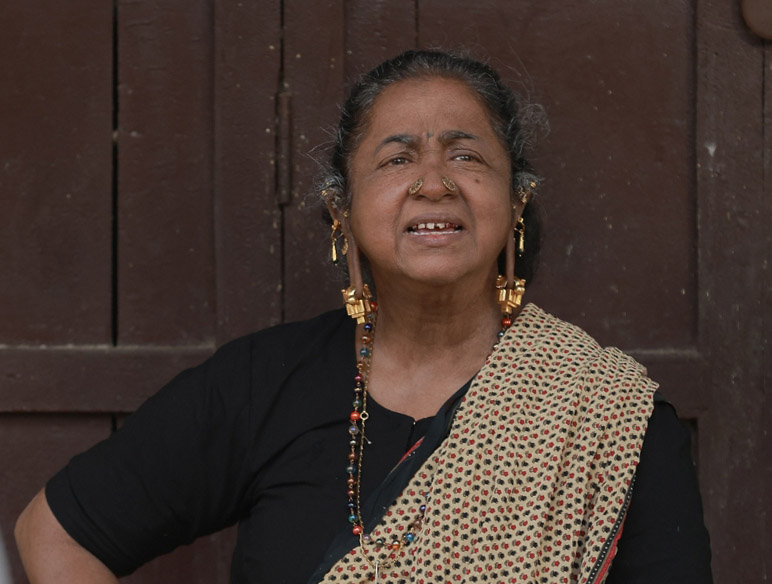
Though the film had a slow first half, I was engrossed in the details of the set design and styling of the characters. The stunning Tamil jewellery and apt clothing along with the superb prosthetic makeup by Vineesh Vijayan brought the main character to life. Her thandatti (earrings on elongated ear lobes) gave her the “main character energy.” I would have seen several woman wear such stone studded nose pins, navaratna style bead chain (mani), gold chain with a safety pin, ear studs on multiple earrings while travelling by bus across towns in Tamil Nadu. She felt familiar, as though I have met her somewhere.
Ethnic Tamil jewellery discussed in the film
There is also a dialogue in Thai Kizhavi that lists various rural and almost extinct Tamil Jewellery as below. Significantly different from those discussed in Silappathikaram, it shows how jewellery styles evolve over time.
(P stands for poun or 8 gms of 22K gold)
For the nose
Mookuthi – nose ring- 0.5P
Bullaku – septum ring- 0.5P
For the Ears
Thandatti – Ear drops representing the cosmos – 1.5P
Koppu – ear lobe stud- 0.5P
Lollaku – Helix ring – 0.5P
Ona kothaati – earlobe drops – 0.5P

For the neck
Kalutu otti – Choker- 5P
Picchipoo malai – Floral necklace with jasmine motifs- 10p
Meenakshi malai – necklace with oval pendant (A long white stone necklace with green glass or stone pendant with a halo of white stones, Adorned by Meenakshi Amman at Madurai) – 15P, 20P
Eda sangili – Side Chain- 10P
Aaram – Haar – long necklace- 22P
Karuga mani malai – black bead chain- 16P
Kaarappu addigai – stiff line choker with Glorisa flower motifs – 11P
Maanga malai – long necklace with mango motifs- 10P
For the hands
Kai vangi – Armlet – 15P
Kal vallaiyal – stone bangles -14 P
Thanga valayal – gold bangles – 20 P
Pavunuthaayi, can be seen wearing most of the earrings, the nose studs and the simpler chains from the list. This is significant as it discusses the ethnic jewellery worn in rural Tamil Nadu, preserving them in current collective memory. These styles are fast becoming extinct as they depend on body modification. Such discussion can prevent erasure and extinction of these styles prompting brands to recreate them.
I hope you find it interesting
Cheers


What do you think?