
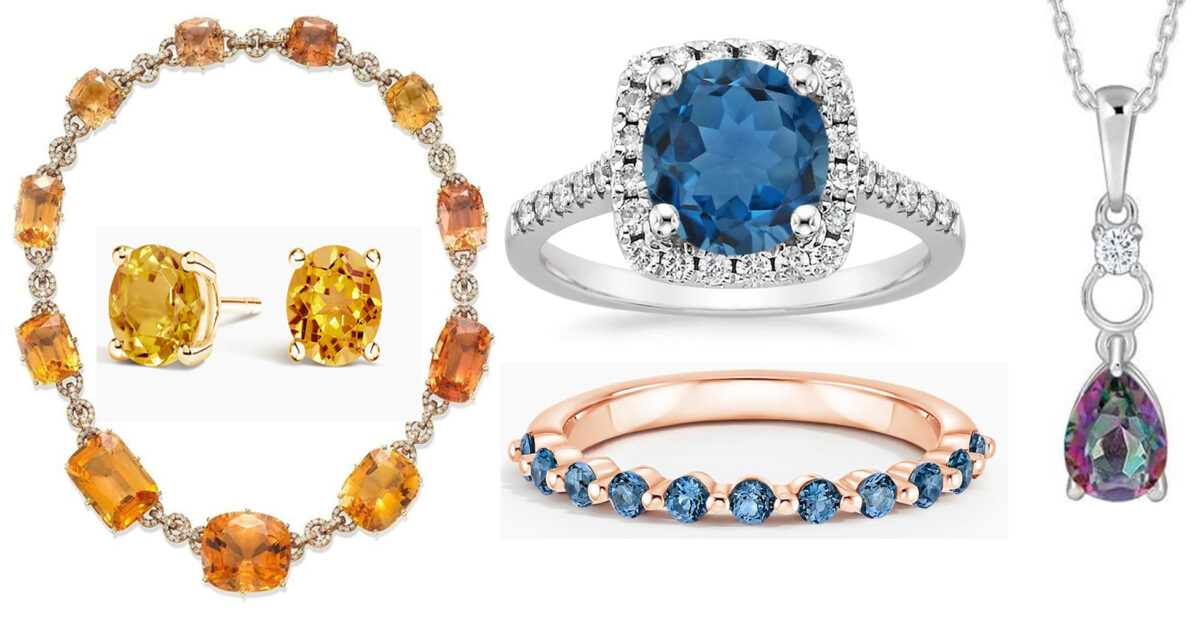
November has two birthstones: Topaz and Citrine. If you think of topaz as being a fiery yellow, then both these stones have a connection. But if you know of all the different colours of topaz, you may wonder what brings them both together. In the post of Citrine as a birthstone of November, I have illuminated how citrine was chosen as it was an affordable alternative to topaz.
Topaz and its colours
For those born in November, topaz offers a palette that extends far beyond yellow. This gemstone occurs in colourless, blue, golden, orange, pink, red, brown and violet shades. “Mystic topaz”, however, is not a colour but a thin artificial coating applied on the gemstone’s surface. Blue topaz is the gem of the fourth wedding anniversary, and the peachish-orange Imperial topaz is the gem of the 23rd wedding anniversary. The colour and quality of topaz vary with its geological origin. In contrast, citrine occurs only in the yellow-to-orange variety of quartz, giving the month two distinctive gemstones.

Colours and their associations
The colours of topaz lend the gemstone different symbolic meanings. The yellow family represents abundance and optimism, while orange and Imperial topaz suggest warmth, vitality and creativity. Blue topaz is often associated with calmness, clarity and effective communication. Pink topaz is linked with affection, tenderness and emotional warmth. These associations are based on contemporary interpretations of colour psychology.

Chemical and physical properties
Topaz is an aluminium silicate mineral containing fluorine and hydroxyl, with the chemical formula Al₂SiO₄(F,OH)₂. Topaz forms in silica and fluorine rich geological environments, in Brazil, Pakistan, Namibia, Nigeria, Madagascar, Mexico, Myanmar, Sri Lanka and the United States. It is a crystal in the orthorhombic with a vitreous, glass-like, lustre. Its transparency, lustre and ability to take a fine polish make it well suited to faceted cuts that reflect light. With a hardness of 8 on the Mohs scale, topaz resists scratching better than many commonly used gemstones. However, hardness does not necessarily indicate toughness. Topaz has perfect cleavage in one direction, meaning a sharp blow can cause it to split or chip.

Topaz jewellery and aftercare
Topaz’s diverse colours lend themselves to both white and yellow gold. Regardless of the colour, it pairs well with pearls and clear diamonds. However, you can pair it with other gemstones such as emeralds, rubies and sapphires depending on the colour of the topaz.
Its perfect cleavage, however, calls for careful setting and wear. Closed or open bezel are preferred compared to prongs, particularly in finger rings and bangles. You can experiment more with necklaces, pendants and earrings. As with any gemstone jewellery, remove it before sports, heavy housework or activities in which it may be knocked or come into contact with chemicals. Avoid sudden temperature changes which may cause damage, particularly if the stone contains internal fractures. Further, intense colours can be the effect of irradiation treatments, and such stones must be treated with even more care. Clean with lukewarm water, mild soap and a soft brush and avoid ultrasonic cleaners despite what IG reels tell you.
Wishing all the November kids a happy birthday with topaz. Find links to the rest of the Birthstone series here.
I hope you find it interesting
Cheers

What do you think?