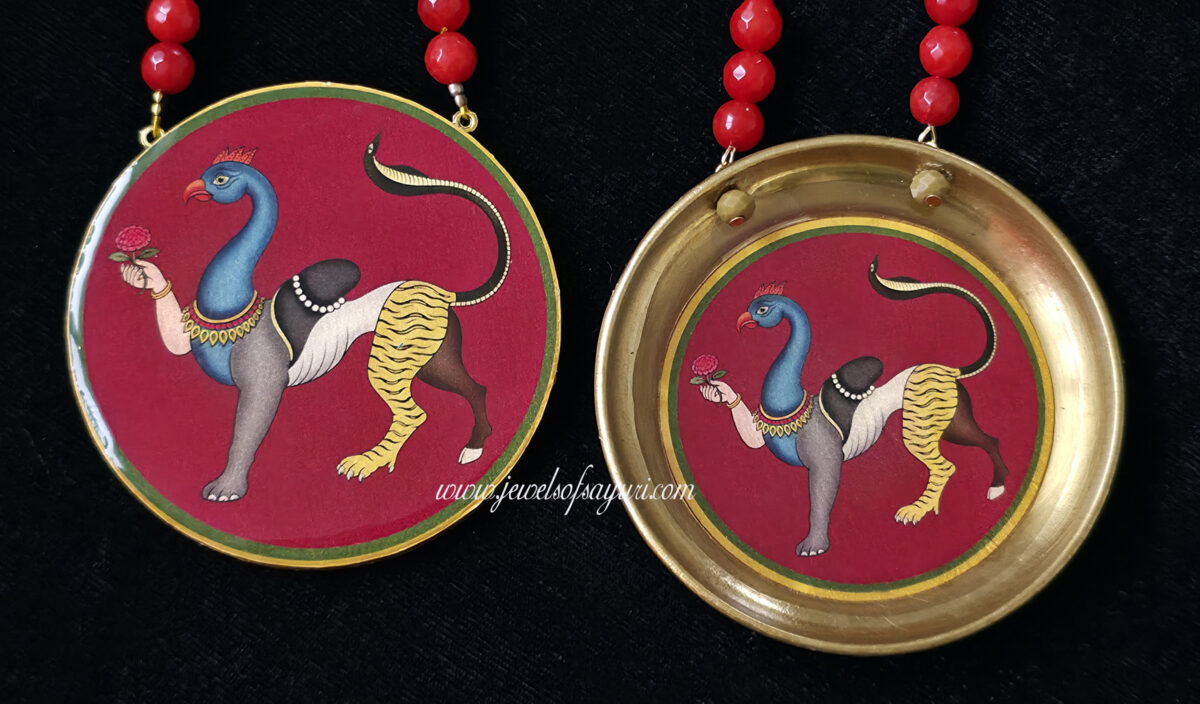
Fantastical creatures, especially, mythological ones, remind me of the possibilities this world has to offer. They make me curious even on the dullest of days and fill me with wonder. I have drawn the Yazhi, the Makara and the Gandaberundha and converted them into jewellery in the past. In continuation, I present Navagunjara jewellery – a pair of necklaces and two sets of earrings.
Navagunjara, much like the Gandaberunda is a manifestation of Lord Vishnu. It is liminal being; a form that asks us to recognise the sacredness in a body that crosses the boundaries between species.
The nine components of Navagunjara
Navagunjara or Nabagunjara is a composite mythical form made up of nava (nine) and gunjara (beings). The form emphasises the principle of interconnectedness between different ecosystems and the beings that inhabit them. The Pattachitra artisans of Orissa, visualise the Navagunjara with the head of a rooster, the neck of a peacock, the hump of a bull, the waist of a lion and the tail of a serpent. Three legs belong to an elephant, tiger and horse or a deer. The fourth limb is a human hand, often holding a lotus, a disc/chakra or a mirror.

According to Pattanaik, et al (2024), the rooster suggests vigilance and the arrival of a new day. The peacock evokes beauty and splendour and the bull stands for strength, endurance and righteousness. The tiger (or lion) represents power while the serpent points to renewal and transformation. The elephant is associated with wisdom and stability. The horse (or deer) represents movement and vitality, and gentleness. The human hand holding a lotus is the intersection of human action and divine grace. When it carries the chakra, the emphasis shifts towards Vishnu’s power to protect.
Odia tales – mythology and folklore
In Sarala Mahabharata, a Odia language retelling of Mahabharata by poet Sarala Das, Arjuna goes on a journey as a penance for breaking a vow to his brothers and their wife Draupadi. In some other versions his journey is internal and he is seeking eternal knowledge. During that journey, Arjuna chances upon a fantastical creature in a forest and is startled. He picks up his bow to shoot the creature when he notices that it has a human hand holding a lotus flower. He understands that there is more to this creature than what meets his eye. Approaching it with humility and wonder, Arjuna realises that it is indeed the divine form of Lord Vishnu or his dear friend Krishna.

In some versions, the Navagunjara speaks to Arjuna (and through him to all of us) asking us see the divine in every creation. He tells us to not let how we are perceived by others bother us for it does not alter our true self. From a mythological standpoint, Krishna explains how every being – living, non-living and in-between is encompassed within him. Therefore, some experts interpret this form of Krishna as they do his cosmic form – Virat roop or Vishwaroopam.
In one folk story, the creature appears when Arjuna is helping Agni, the God of fire consume the Khandava forest. This is meant to make Arjuna rethink his actions about destroying an ecosystem. However, this version directly contrasts most popular versions of Mahabharata which state that both Krishna and Arjuna both aid Agni and later construct the Pandava Capital Indraprastha on those lands. But this ecological perspective is crucial for us at this moment, as we are destroying green lands to build data centers.
Navagunjara as a motif
As a motif, the Navagunjara is a great example of unity with variety. Rather than homogenizing its parts to fit the whole, it retains the identities of its constituent creatures. And yet, it is divine. It shows us how the world and the beings in it are diverse and interconnected. That is why as a system, the world or creation is worthy of reverence.
The form Navagunjara is widely painted in Odisha’s Pattachitra tradition and can be seen on the walls of several houses at Raghurajpur. It appears in Ganjifa playing cards as the king card (with Arjuna as the minister). Though not as common as the Yazhi or Gandaberunda, the Navagunjara can be found in various regional handlooms as a textile motif. However, I am yet to find Navagunjara jewellery, so I decided to make my own.


Navagunjara jewellery
I have been fascinated with the Navagunjara for a long time and wanted to purchase a statue or painting. Eventually, I drew a digital illustration using Adobe Photoshop and a mouse (no stylus). At the time of publishing this post, I have created two very different necklaces using the same beads in the same colours. I have used dyed agates, dyed quartz, and some dyed glass crystals in red, maroon and dull gold. The single line looped bead version is shorter and the pendant is a tiny brass plate.


The layered Navagunjara necklace is longer and the super glossy pendant has an MDF base. The size of the image is bigger on the double layered necklace than the single. Out of the two layers, one is strung and the other is looped. This is the first time I have tried this combination. I was worried as it kept turning while taking photographs. But it falls perfectly when you wear it.
Navagunjara earrings
I used the same image to make statement earrings. Wearing them as a set with the necklace or separately depends on the wearer.


I have started posting the photos of the Navagunjara jewellery on Instagram and I am glad to know that they are well liked. I have also gotten some customisation requests which are interesting because it tells you who the customer is and what they want. Maybe I will keep one of these necklaces for myself, and make variations to sell.
I will be posting a reel shortly so that you can see how the necklaces look when they are worn. In the meanwhile, so share your comments and suggestions in the comments.
I hope you find it interesting
Cheers

What do you think?