
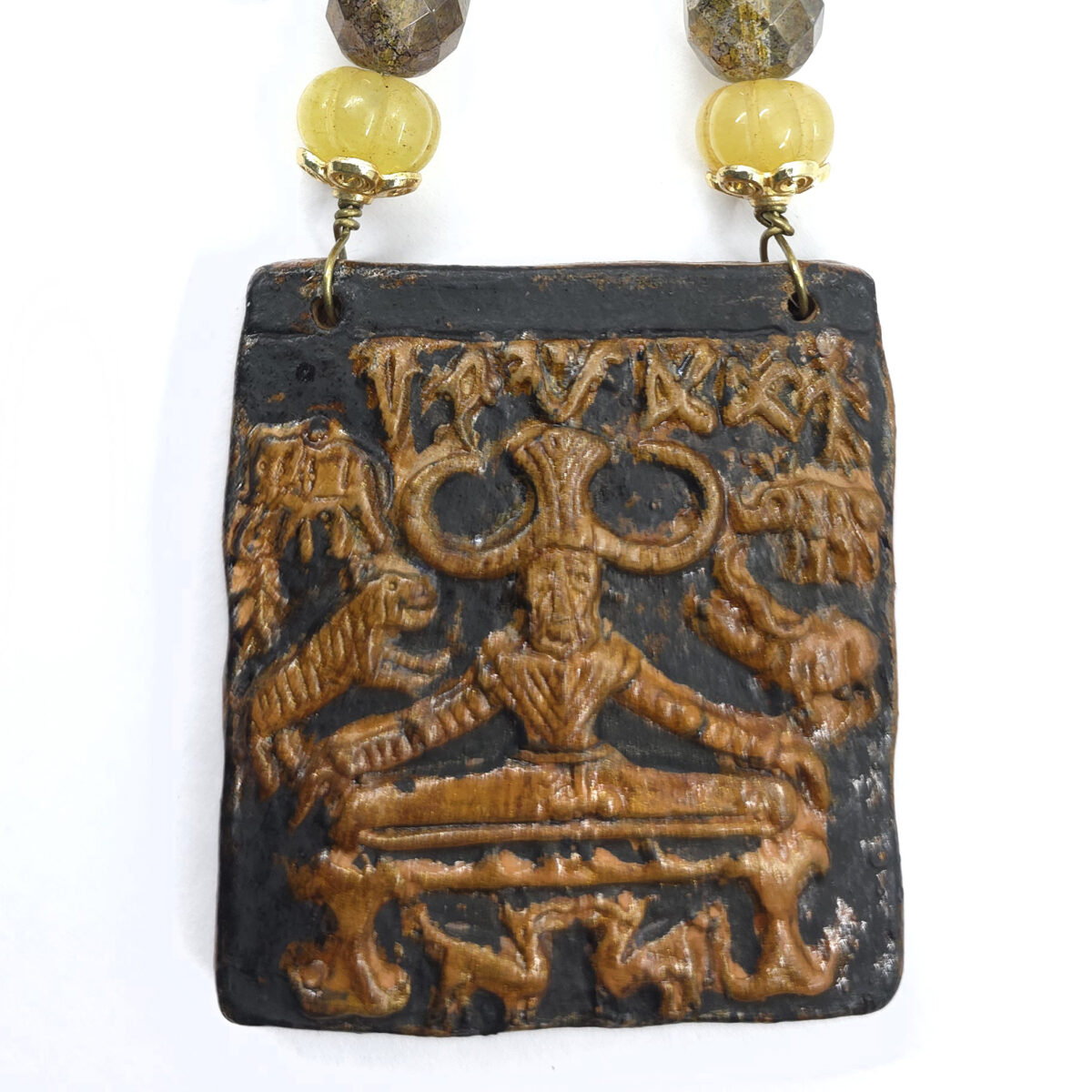
In 2025, I purchased two pendants from Madygraphy resembling Harappan seals. I made the Rhino seal into the Rhino seal pendant necklace. I had mentioned in that post that I was dabbling with various finishes for the Pashupati seal and that I would finalise an option based on the beads that I wanted to use. Eventually, I opted for a black finish and strung the pendant with beads of various shapes and colours, maximising it potential of matching various outfits. Here is the Pashupati seal necklace with gold tone findings, Czech glass, glass and quartz beads. However, the value of the Pashupati seal necklace comes from the highly contested image as seen on the seal-pendant.

Pashupati seal
In 1931, John Marshall while directing the excavations at Mohenjo-daro (present day Pakistan), interpreted the figure on a seal as proto-Shiva or Pashupati, the Lord of Animals. The broken seal contained a central figure of a man wearing a horned headdress, surrounded by animals. This seal came to be then known as the Pashupati Seal. Not many know that there are two Pashupati seals. One with the animals and one without. Interestingly, both figures wear bangles. Based on the exhibits at Keezhadi museum and Dhalavira, I am inclined to think that these were shell bangles. The interpretation of the figure as Lord Shiva (who is also known as Pashupatinath in Nepal) helped construct a possible continuity between the presently unidentified Harappan religion and later Vedic and Hindu traditions.

However, the identification remains contested. Scholars such as Jonathan Mark Kenoyer have cautioned against projecting later Hindu iconography backwards onto the Harappan image. There is also a question of whether the human form in both seals are male and if they are the same person/form/deity. Was this figure symbolic, signifying the mastery of humans over animals? Or did it showcase the co-existence of human and the animal world? You can watch historian, author and religious scholar, Devdutt Pattanaik’s analysis of these seals in the video below.
Pashupati, Pashupata, Pothuraju, Master of Animals
People in the comments section of the video talk about Pothuraju, a guardian deity worshiped by Telugu speakers. The term “Pothuraja,” they mention means king of animals. His association with protection, cattle and agrarian communities makes him especially interesting when considered alongside the Harappan emphasis on powerful animals.
Chhattisgarh Bastar’s Bison Horn Maria tribe has rituals associated with a pastoral deity and wear horned headdresses. Mhasoba of Maharastra is a buffalo folk god. Buffulo gods are also worshipped by the Toda tribes of Nilgris. Were these practices derivation of those from Harappan times, we do not know.


Whenever I teach Costume and cultural history, I ask my students to observe similarity in objects and practices across cultures. I often draw a comparison between the Pashupati seal and the Master of Animals pendant, from the Aegina Treasure. There is also a Egyptian master of animals, an Achaemenid seal and the famous panel from the Gundestrup Cauldron, as seen above. The resemblance might not demonstrate cultural transmission between these worlds. Rather, it could indicate that similar practices and belief systems that emerged across the world. In this case, it was the human–animal relationship where divine or human authority was implied through protection and control over nature.

Coming back to my Pashupati seal necklace, I have worn it a couple of times and might change the beads soon. Please do suggest alternatives. I wore it to a Harappan exhibit and once to Dholavira and felt a great sense of pride and satisfaction. It was fun to imagine what the Harappans might think about wearing a seal as a pendant and ofcourse, my necklace.
I hope you find it interesting
Cheers

What do you think?