
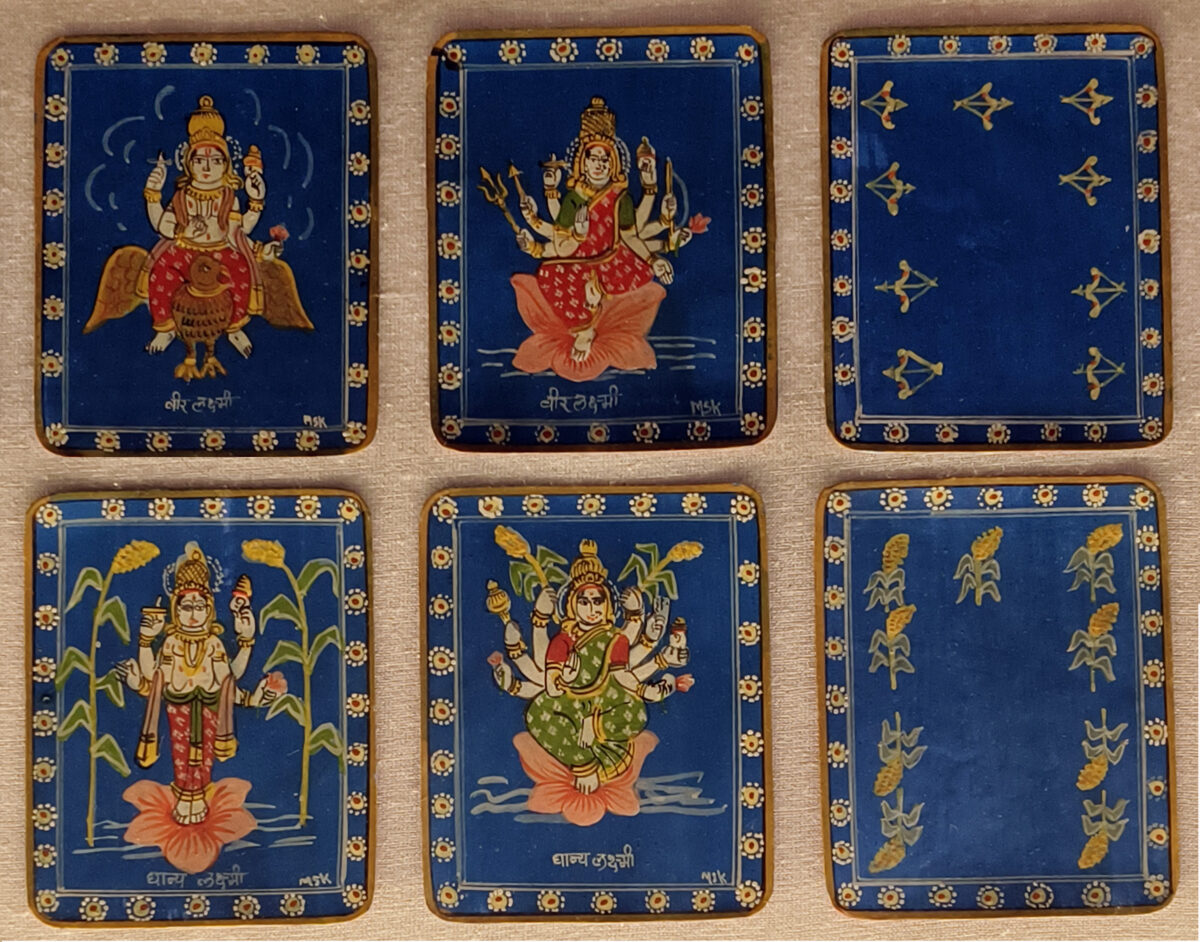
Tucked away inside the Hasta Shilpa Heritage Village in Manipal, Karnataka, is an exquisite gallery of Ganjifa cards. The gallery is a visual archive of mythology, craftsmanship, gaming traditions, and regional artistic practices. The exhibit is built around the ways in which different communities reinterpreted the game using their own stories, deities, and artistic conventions. I had the opportunity to experience it earlier this year and was spellbound.

What are Ganjifa cards?
The word Ganjifa is derived from the Persian ganjifeh meaning playing cards. The game is believed to have reached India during the Mughal period, around the sixteenth century. Emperor Akbar is credited with modifying the Persian deck into an Indian version consisting of eight suits and ninety-six cards. The courtly pastime evolved into a religious one with Brahmins playing with round painted cards depicting Hindu deities. Shortly, thereafter, each region in the country had its own form of the game. There was the Sawantwadi Ganjifa from Maharashtra, Navadurga Ganjifa from Orissa, Rajasthan and Gujarat Ganjifa , Kashmir Ganjifa, Nepal Ganjifa and the Mysooru Ganjifa which was greatly patronised by the Mysore Royal family during their reign. There could be as many as 144 cards in a deck.

Historically made using ivory, tortoise shell, mother-of-pearl, or lacquered wood the cards then came to be made using paper mash or handmade paper.
Ganjifa exhibit
The exhibit showcases original painting tools, natural pigments, brushes, and unfinished cards, offering valuable insight into the artistic process. A panel explains the history of the game, regional centres of production, methods of preparing the cards, and the traditional rules of play.

Making Process
To create the base, several sheets of handmade paper or cloth are pasted together using natural adhesives such as gum arabica. Once dry, circular discs are carefully cut and burnished until perfectly smooth. A chalk or stone powder coating mixed with gum is then applied to prepare the painting surface. After repeated polishing, artists sketch the central composition. While some cards in the deck will have elaborate forms, others will have simple motifs of flowers or animals. Finally, decorative borders are painted in contrasting colours. Finally, the cards receive a protective lacquer coating that enhances their durability and brilliance.

Colour plays an essential role in Ganjifa art as they help organise the deck. Different suits are distinguished through their backgrounds, allowing players to identify them instantly during gameplay.

Forms, styles and stories
Although designed for gaming, Ganjifa cards function equally as miniature paintings. Some cards depict complete mythological scenes, while others use symbolic objects to identify numerical values within a suit. Apart from the popular Dasavathar Ganjifa featuring the ten avatars of Lord Vishnu before, the exhibit had rare card collections. Those that featured planetary bodies (grihas), Zodiac signs (rashis), and constellations of stars (Nakshatras) were intriguing. Some decks told an entire story – such as the Ramayana while others presented a collection of beliefs. There were rectangular cards with text as well as triptychs. I wish that I had known more about these cards when I used vintage prints of round Zodiac Ganjifa cards in my Chitra Katha collection in 2014.

Hasta Shilpa Heritage Village
The Hasta Shilpa Heritage Village (HSHV) is a collection of eleven traditional houses and two monasteries converted into art galleries. It is close to the Manipal lake and is about 5-6kms from the Udupi Krishna temple. Arranged like a settlement, it offers a peek into ancient craftsmanship and living traditions of Karnataka. The Ganjifa gallery is one of their permanent displays but the other houses/galleries are beautiful as well. You can see carved wooden decor, various folk painting traditions, bronze idols and houses with coloured glass roof and windows. Remember to wear comfortable clothes and shoes to help you walk around. Only small purses/phones and water bottles are allowed and bigger bags, especially backpacks must be stored in the office. It would take anywhere from 2-4 hours or more to see it.

Ganjifa is special because it showcases the convergence of artistic traditions, storytelling, religion, and material culture. I hope that you get the chance to visit HSHV and admire their collection of Ganjifa cards.
I hope you find it interesting
Cheers

What do you think?