
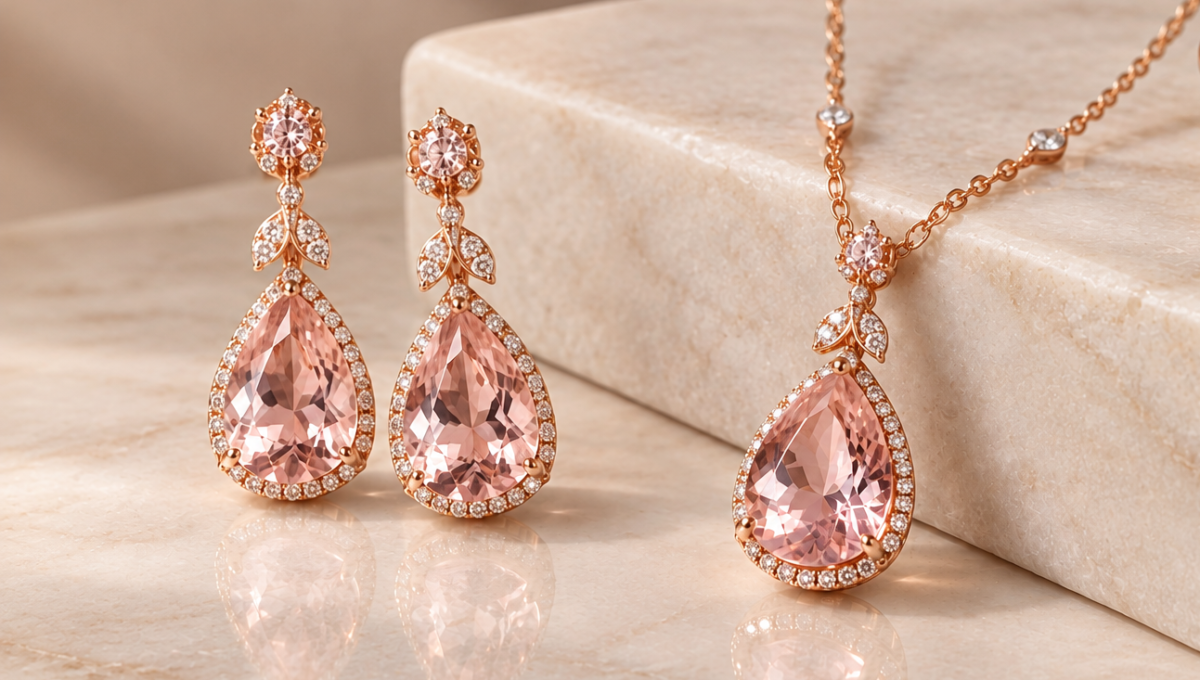
There is something almost dreamlike about morganite. Its delicate blush, peach, salmon and rose-pink tones have given it an unmistakably romantic presence in contemporary jewellery. Often seen glowing against rose gold, the stone has become particularly popular in engagement rings and bridal jewellery. Associated with romantic love, its soft colour offers an alternative to the traditional white diamond.
Morganite belongs to the beryl family, alongside emerald and aquamarine. However, it is incorrect to call it “pink emerald.” GIA specifically regards the term as misleading and recommends using morganite or pink beryl. Morganite may appear pale pink, rose, purplish pink, peach or salmon, with some stones showing a warmer orangey-pink appearance. Strongly saturated pink is uncommon, which is one reason intensely coloured stones attract particular attention.

Morganite Facts
Morganite was discovered as a new pink beryl locality in Madagascar around 1910. The gemologist George Frederick Kunz, who was then closely associated with Tiffany & Co., examined the material and proposed the name morganite at a meeting of the New York Academy of Sciences on 5 December 1910. The name honours John Pierpont (J. P.) Morgan, the American financier and renowned gem enthusiast. He commissioned Kunz to acquire mineral specimens and was responsible for major donations and purchases that became part of the collections of the American Museum of Natural History. The first specimens from the Madagascar deposit were reported in 1911.
Morganite is the pink to orange-pink variety of beryl, the same mineral species that includes emerald and aquamarine. Its chemical composition is beryllium aluminium silicate, with the chemical formula Be₃Al₂Si₆O₁₈. In morganite, the delicate pink colour is principally associated with manganese. The gemstone has distinct pleochroism, meaning its colour can appear slightly different when viewed in different crystallographic directions.

Morganite commonly forms in granitic pegmatites, geological environments famous for producing exceptionally large crystals of minerals such as beryl, tourmaline and spodumene. Pegmatites form from mineral-rich fluids associated with cooling magma, allowing crystals to grow to extraordinary dimensions. This explains one of morganite’s most extraordinary characteristics: size. Brazilian miners have found morganite crystals weighing around 10 kilograms. The “Rose of Maine” weighs over 50 pounds.
Symbolism – the stone of romance
The association of pink with affection, romance, tenderness and femininity also predates morganite itself. But it helps explain why a pink gemstone feels especially appropriate for jewellery exchanged in relationships and rites of passage.

Gemstone and jewellery care
With a Mohs hardness of 7.5–8, morganite is reasonably durable for jewellery. It is, however, less resistant to scratching than diamond, sapphire or ruby. It can be scratched or chipped when not treated with gentle care. Therefore, a bezel setting can provide considerable protection around the stone. The gemstone is more suitable for earrings, pedants and brooches. Store the piece separately from harder gemstones to reduce scratching.
I hope you found it interesting
Cheers

What do you think?