
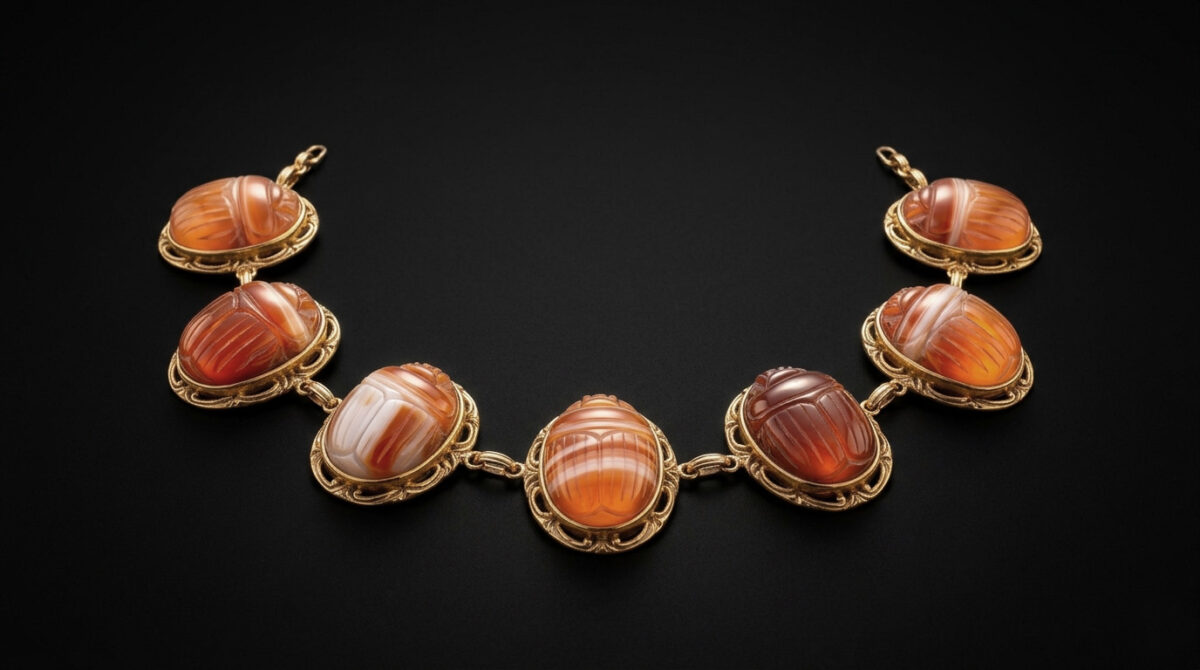
In the birthstone list that came out in 1912, the gemstone Sardonyx was the birthstone of August. Soon Peridot took over and later Spinel was added to the list. Though India produces a large amount of Sardonyx, it is relatively unknown. It is often confused with chalcedony, carnelian and even hessonite.
Gemstone Sardonyx
Sardonyx is a combination gemstone of two varieties of chalcedony. It combines sard, the reddish-brown or orange-brown stone, and onyx, that can be identified by almost straight bands of white, grey or black. Sard + onyx = sardonyx. As a result the stone, has a dramatic visual appearance. Made up of silicon dioxide (SiO₂), it is a microcrystalline (cryptocrystalline) form of quartz. It has a refractive index of 1.530 to 1.543 with 2.6 density.

India is known for sardonyx with good contrast between its layers. Other reported sources include Sri Lanka, Brazil, Germany, Madagascar, Uruguay and the United States.
Sardonyx Vs hessonite
Hessonite is an orange grossular garnet whereas the gemstone sardonyx is a banded chalcedony. Known as Gomedakam (Gomed) in India, it is a part of the Navaratna. Interestingly, Sardonyx is sometimes called as Gomed creating a confusion.

Mythical associations
In the King James English translation of Revelation 21:20, sardonyx is named as the fifth of the twelve foundation stones of the New Jerusalem. However, in some other translations of the Bible, the same stone is called onyx. In my post on Birthstones by month and Rasi, I had written about the Breastplate of Judgement mentioned in the Book of Exodus. Some of its interpretations list two of the gemstones as Sard and Onyx. In others, the term Sardonyx appears. As with all ancients texts and objects, this is also subject to both one’s belief and accuracy of the language analysis.
GIA notes how sardonyx is associated with the strength of spiritual life. Roman soldiers wore sardonyx rings carved with the image of Mars, believing them to offer protection in battle. As a birthstone it is associated with courage, happiness, communication and stability in relationships. The gemstone is used for energy healing and for goal manifestation.

Sardonyx in jewellery
It is a relatively soft stone with a hardness of 6.5 to 7 on the Mohs scale. Therefore, it lends itself well to carving and polishing. Historically, it was used to create Cameo or intaglio cabochons that could be set in metal settings. It was used for seals and signet rings.
At the present, inexpensive dyed sardonyx cabochons (Rs.400-800 per stone) are wire wrapped as pendants and earrings. Sardonyx beads are typically dyed and can easily be confused with dyed onyx or agate.
While the gemstone is more suited for earrings and pendants rather than everyday rings, it is sufficiently durable to be worn as a bracelet or ring occasionally. Care must be taken while cleaning as it is often dyed to bring out a deeper colour.
Unlike translucent gemstones which sparkle, Sardonyx’s appeal lies in its layers. The streaks or bands, their colours and patterns add to the value of the stone. I wish that more designers would work with it.
I hope you find it interesting
Cheers

What do you think?