
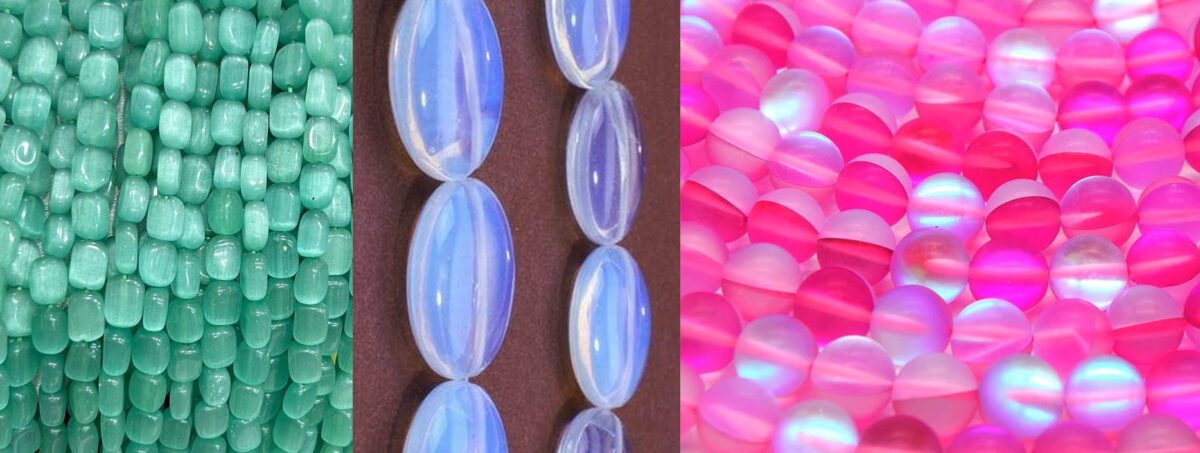
Monalisa beads, gleamy moonstones and aura quartz – what do these three types of beads have in common?
They are glass or synthetic beads with finishes, incorrectly, sold as gemstones. If you have ever wondered about the different between these beads, here is an explainer post.
Monalisa beads
Monalisa or Monolisa beads are imitation of natural cat’s eye gemstone. They gleam and catch the light as a strip of light. The effect is more pronounced in round and teardrop stones than in ovals and flat beads. When used as multiple strands (in necklaces and bracelets), it gives an almost satiny-feeling to the piece.

The chatoyancy effect (reflectance phenomenon) here is not a surface finish alone. These beads have horizontal filaments embedded inside to produce the optical illusion. This is a value-add used to upgrade reconstituted glass beads and synthetics. They are in high demand as a the hardness of the tempered hydro-glass or synthetic stones make them more durable (and many times cheaper) than natural cat’s eye gemstone. The treatment also improves the finish of the dyed or coloured beads which look tacky. The gliding band of light will almost always be horizontal and not vertical. It will also be more prominent and a starker white line compared to the effect found in natural gemstones which a lot of people like.
Personally, I find the chatoyancy effect too gaudy in case of bright colours such as teal, pink, violet and orange. It is probably my brain telling me that these beads can never occur naturally.

Gleamy moonstones
A moonstone is a natural, iridescent feldspar mineral known for its inner glow known as adularescence. However, a gleamy moonstone is a faux or synthetic moonstone. It is made of glass or synthetic materials and has an an adularescene finish. Unlike a natural stone, it will look shiny from all angles. This is the reason it is more preferred in costume jewellery compared to natural moonstone which can look dull from certain angles. Alternatively, it will look plasticky if its made of resin. A similar, yet slightly different bead type is an imitation Opalite which can be recognised by its blue colour.

Aura quartz
Aura refers to the soft and subtle coloured glow a glass bead has. At times reconstituted quartz is used to make aura quartz but most of the times it is glass. I have also seen acrylic beads with the same finish. Its difficult to differentiate them from images. You need to hold them, to know their weight, their clink (sound they make when they touch a hard surface) and the texture. Synthetic beads have seams and a smoother finish compared to glass beads.
Monalisa beads, gleamy moonstones and aura quartz are trade names. To confuse them with typology of natural gemstones is futile at best. Trade names are often poetic or special to create a memorable recall and add an element of fascination. Therefore, learning to distinguish between trade names used for marketing and technical terminology will save you time, money and energy.
I hope you find it interesting
Cheers


What do you think?