
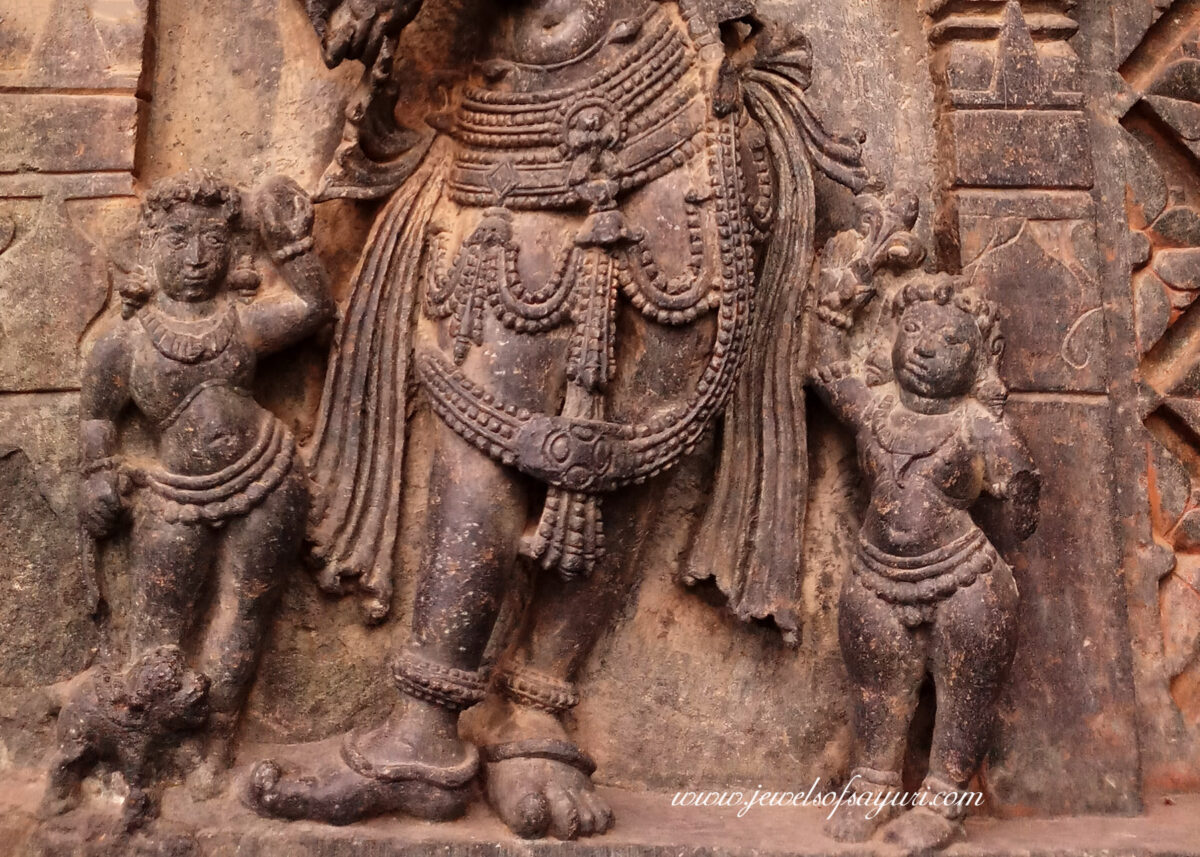
Indian designer Rahul Mishra’s collection Devi, presented at the Paris Couture week Fall 2026 has won a lot of accolades. Single thread embroidery along with beadwork has been used to make the clothes and their wearers look like 12th CE stone statutes. With forms and motifs inspired by Hoyala Architecture, as seen at Belur and Halabedu, the collection has sparked conversation about Indian architecture, sculpture, and aesthetics. But hastily written reports by western media and subsequent reels by self appointed fashion journalists/influencers have gotten several facts wrong. My reel on alamkara is an attempt to debunk the myth that ancient India prioritised jewellery over clothing and textiles. This post and its condensed version as a reel are to state that all Indian waist/hip ornaments are not mekala. They have different names in different texts and in different time periods.

Further, as these ornaments are not religious and not restricted to practitioners of the Hindu faith. Several statues of mortal women and yakshis (nymphs), can be seen wearing decorated waist girdles at Buddhist sites such as Bharhut, Sanchi, Amaravati and Mathura. In the Tamil epic, Manimekalai, the protagonist Manimekalai becomes a Buddhist nun!

Coming back to the Devi collection, the embroidery at the waist and hip resembles ornaments such as araipatti, tarakaichumai and kuranguseri. The hip ornament with scallops of pearl chain that most of the internet is calling as mekala is kuranguseri (Tamil). Forms that resemble mekala can be seen in 1-2 garments only. Read on to understand each ornament in detail.

Kuranguseri
Kuranguseri/Kurangusari is a hip ornament with scallops of pearl or beaded chain. It is also known as Uru Taman, and Kavanaseri meaning that it is the ornament that graces the thigh. In the book, Home Life Among The Tamils in the Sagam Age, the author K Gnanambal says that this ornament could have been used as a girdle to keep the saree or lower garment in place. It would indeed be useful when one is wearing a slippery fabric, multiple layers and/or wants a fit an flare silhouette.

What is a Mekala
A Mekalā (Sanskrit) or Mekalai (Tamil) is an ornament worn on the lower waist and hip. It has a rigid center focal that acts as a multi-strand connectors to multiple strands of beads and pearls. It is typically tied at the back using a rope (dori) or a piece of fabric attached to the bead strands. The knots could be made in different ways creating different patterns at the back. A design variation in that of the center front focal acting as a clasp. Further, the central focal can be horizontal or vertical depending on the number of strands of beads used. Beyond acting as a belt for the antariya (lower cloth), it functioned as an ornament that is shaping the body, a rhythmic instrument for dance, a marker of femininity and fertility, and a visual device that accentuated movement of the hips during a dance performance.

Its design and evolution an be traced across Nāṭyaśāstra, Śilpaśāstra, Tamil Sangam literature, epics such as Silappathikaram, temple sculpture to Indian films. A mekala could be made of bead chains, pearl strings, jewel settings (visualise rhinestone cup chains), and linked metallic elements.
Ornaments such as the mekala could have 32, 64 or even 108 strands of beads. Different texts define it differently. According to the book Indian sculpture and iconography, a mekala has to have a minimum of three strands of beads as per Śilpaśāstra. As per Nāṭyaśāstra, a mekala is an ornament with eight strands of pearls or beads. In Silappathikaram, Madhavi is described as wearing a mekalai with 32 strands of pearls over a blue embroidered lower garment. Interestingly, most of the Yakshis at Sanchi stupa or Bahrut are wearing mekalas of four strands. I do not know if it has a specific name.

In my post on jewellery as described in Nāṭyaśāstra, I have specified various waist and hip ornaments such as Kāñcī (single strand of beads), Raśanā (16 strands), Kalāpa (25 strands), and Kulāka. These are old Sankrit terms. Others include araipatti – half band which is a stiff waist belt, Kamarakandigai (a necklace for the lower waist) and Tarakaichumai (Tarakai means stars) – a gemstone encrusted band. These are Tamil terms and the same objects might be called differently in other languages.

Popularity of mekala
The Mekala was simultaneously practical, decorative and performative. Unlike a belt, a mekala did not cut the body into two rectangular blocks. It sat just above the hips, below the navel following the curvature of the pelvis. It accentuated the oscillation of the hips, reinforcing rhythm and visual grace. The beads flowed with the body, particularly as dancers strikes a pose. This could have also been true of models posing for the sculptors. Even today the “S” silhouette is most popular in fashion illustrations and shoots.
We do see remnants of mekala in the waist and hip ornaments worn by dancers in the 20th and 21st century as well. While grand versions used to be worn in dream song sequences of Indian movies in the late 1980s, simpler versions can be seen as bridal jewellery and concert jewellery at the present. However, it is worn on the waist instead of the hip to facilitate sitting comfortably without damaging the piece.
As mekalas can be easily created using bead stringing, I hope to see more variations in the future.
I hope you find it interesting
Cheers

What do you think?