
The term “picturesque” refers to an aesthetic category that emerged in the 18th century, particularly in the context of landscape art and literature. The picturesque movement emphasised the beauty found in irregular, rustic, and natural scenes. Picturesque paintings often featuring elements like rugged landscapes, ruins, and visually striking architecture and idyllic settings. Developed by writer William Gilpin and designer Sir Uvedale Price, the theory was a reaction against the more formal and structured ideals of classical beauty and sought to celebrate the charm of the imperfect and irregular.

In the visual representations of colonial India, artists such as Thomas Daniell often sought to capture the sublime aspects of the landscape, featuring majestic mountains, dense forests, ancient ruins, and architectural marvels. The picturesque aesthetic was particularly evident in paintings, drawings, and lithographs that aimed to convey the exotic and romantic qualities of the Indian subcontinent.

The original paintings soon multiplied as oleographs and chromolithographs printed and sold all over Europe as “illustrated travelogues of India.” Photographers followed creating postcards and souvenirs.

The politics of Picturesque images
The picturesque representations helped create an image of a mysterious and exotic land. It reinforced the idea of the British as explorers and rulers of distant and intriguing territories. These images played into the colonial narrative of the “Oriental Other.” They portrayed India as an evocative place of mystique and difference, helping the British to establish a sense of cultural superiority. This was to reinforce their dominance and justify their presence in India. Therefore, liberties were often taken in the portrayal of the sites. People were painted in miniature, scattered as embellishments, faceless, with generic clothing.

Tourism and Souvenirs
The picturesque images were used to promote trade and commerce, strengthening the economic interests of the British Empire. They were employed in marketing materials, such as tags and packaging, to evoke the allure of Indian goods and products. Further, they served as souvenirs for British travellers who visited India during the 19th and early 20th centuries. The souvenirs allowed tourists to capture the essence of the exotic landscapes they encountered.


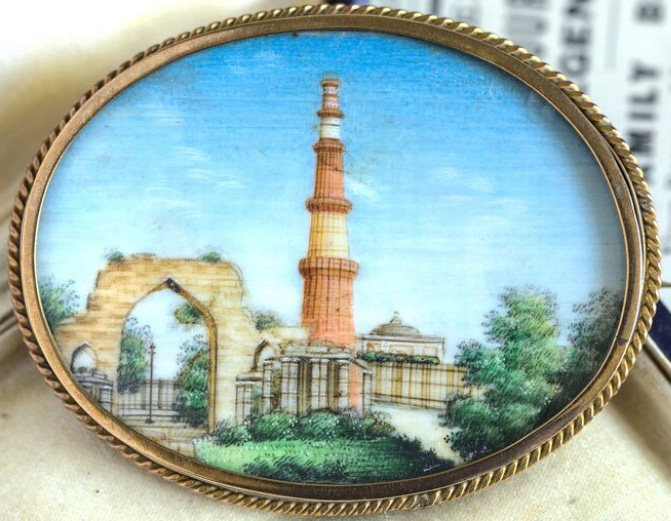
Paintings of Taj Mahal and Qutub Minar set into brooches.
Many of them can be found online in auction sites and on Etsy as modified pendants.
Picturesque picture jewellery
Jewellery with Indian motifs and picturesque visuals, became popular as wearable stories and gifts for those back in Britain. Many of the pieces were modelled after the Grand tour jewellery sold in Europe, especially in Italy. Picture jewellery helped sell the idea associated with the place. For example, a Taj Mahal brooch was sold as symbol of love and promise.

Contemporary adaptations
The picturesque effect has lingered in India, even after Independence. It found its way into calendars, travel brochures and photographs of tourist spots. I see its traces even in social media posts of travel bloggers who romanticise both natural and constructed landscapes. However, picturesque picture jewellery is scarce in contemporary India and I can only cite my own previous work as examples in the 21st century. If you know of anyone else, I would love to know about them.

In my early stages of working with picturesque images, I used colonial postcard images of Chennai, then Madrasapatinam and Mahabalipuarm in my Patinam collection in 2017. While I continued to work with architectural spaces such as palaces and temples, I used digital illustrations and photographs to decolonise my way of looking at these spaces. There was a significant difference in the way the images and in extension the jewellery was perceived.
Eventually, in 2024, I worked on blending the styles together. I created a pendant using an image of a marvel that is part natural and part man made. While the composition and editing drew from the picturesque theories, it looked at the space (both the space depicted as well as the space it occupied on the necklace) from the perspective of personal and cultural memories.

More about the place and design in the part two of this post. Until then, do check out my chapter “Framing memories as Picture jewellery” (Chapter 9) in an upcoming book “Cultural Heritage in the Fashion Industry: From Tradition to Innovation in India” published by Routledge in which I write about the above mentioned piece of picturesque picture jewellery. You can find a major portion of the chapter in the Google books preview here.
I hope you find it interesting
Cheers


What do you think?