
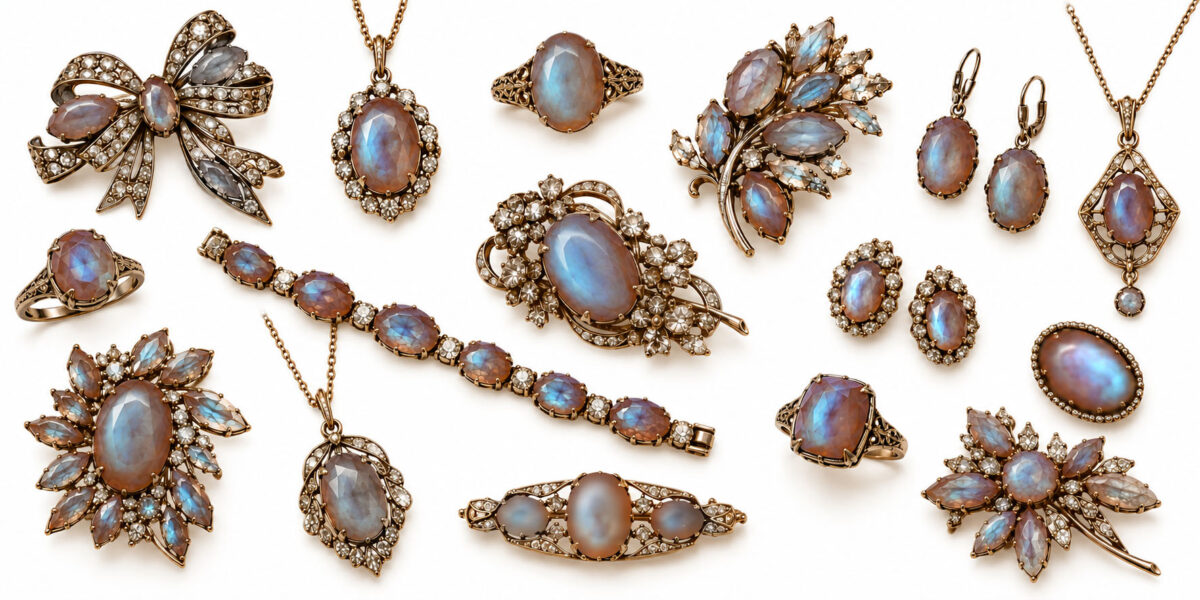
I just came across the most stunning blue-brown gemstone jewellery that I have ever seen and to my surprise the Facebook post that I saw them on told me that they are not gemstones at all. It was jewellery with saphiret, a man-man dichroic stone. Saphiret looks like a gemstone, behaves like glass and, depending on the light, appear to change colour before your eyes. The glass stones have contrasting brown and blue appearances depending on the direction and kind of light.
What is Saphiret
The exact origins of the stone or the technique is unknown. However, according to Clarice Jewellery, Saphiret emerged during the nineteenth century in the town of Gablonz, Czechoslovakia. The local glassmakers experimented by incorporating a very small quantity of gold into sapphire coloured molten glass. Where they trying to create a faux labradorite, I do not know. But the process created an opaque, shimmering material with a warm brown or reddish base and an unexpected blue reflection. The body of the glass can range from mocha and pinkish brown to brick red, while reflected light produces a soft, almost luminous blue effect. More the gold, less the blue glow.
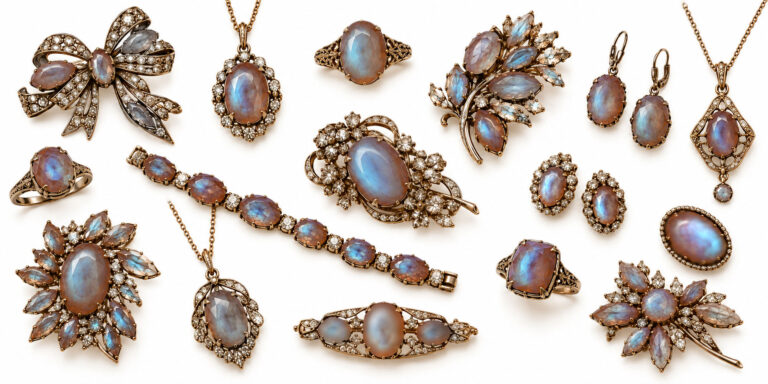
Saphiret jewellery
Saphiret became particularly fashionable during the Victorian period. Jewellery designers and makers experimented with unusual materials, colours and visual effects. Its unusual appearance gelled with the elaborate aesthetic of nineteenth-century. Its use gradually reduced during the Edwardian era and Arts and Crafts movement with stones being set in brass instead of gold.
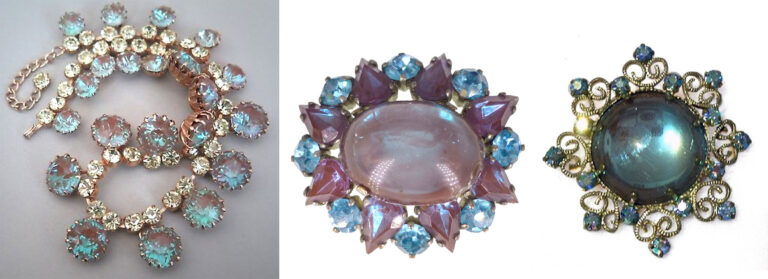
Difference between saphiret and sappharine jewellery
Sappharine stones were first created in Germany (probably in the 1950s) to mimic saphiret. According to Diana DeMango, sappharines have a consistent colour. They also Sappharines look faded compared to saphiret with lesser contrast between the blue and brown. Sometimes moonstones, opalites and other glass stones can be labelled as saphiret or sappharine. As these stones are no longer made, ask for the provenance certificate before you buy.
I love stones with visual phenomenon. Saphiret, though man-made, moves with the light and the wearer. It can look understated or dramatic depending on how and where you wear it and how you sit, stand or move. Fascinating, isn’t it?
I hope you find it interesting
Cheers

Leave a Reply